A Foundational Framework for Behavioral Institutional Design
Executive Summary
For centuries, institutions—governments, schools, corporations, and social systems—have been built on a central assumption: that human beings, when given clear instructions, will act rationally and comply accordingly. This assumption has shaped policies, governance models, education systems, and organizational management structures across the world.
However, modern behavioral science has fundamentally invalidated this premise.
Human beings are not consistently rational. They are influenced by context, shaped by environment, guided by cognitive shortcuts, and disproportionately affected by default conditions. As a result, instruction alone is insufficient to produce reliable, scalable, and predictable outcomes.
This doctrine establishes a decisive shift:
Effective institutions are not built on instruction. They are built on systems that design behavior.
The Life Revolution Institute presents this doctrine as a foundational framework for institutional transformation—moving from compliance-based governance to behaviorally engineered systems.
Part I: The Failure of the Rational Actor Model
1.1 The Classical Assumption
Traditional institutional design is rooted in the “rational actor model,” which assumes that individuals:
- Process information logically
- Weigh costs and benefits accurately
- Act consistently in their best interest
- Follow rules when they are clearly communicated
Under this model, the role of institutions is straightforward:
- Define rules
- Communicate expectations
- Enforce compliance
If outcomes fail, the assumption is that individuals need more education, stricter enforcement, or better discipline.
This assumption is deeply flawed.
1.2 Behavioral Reality
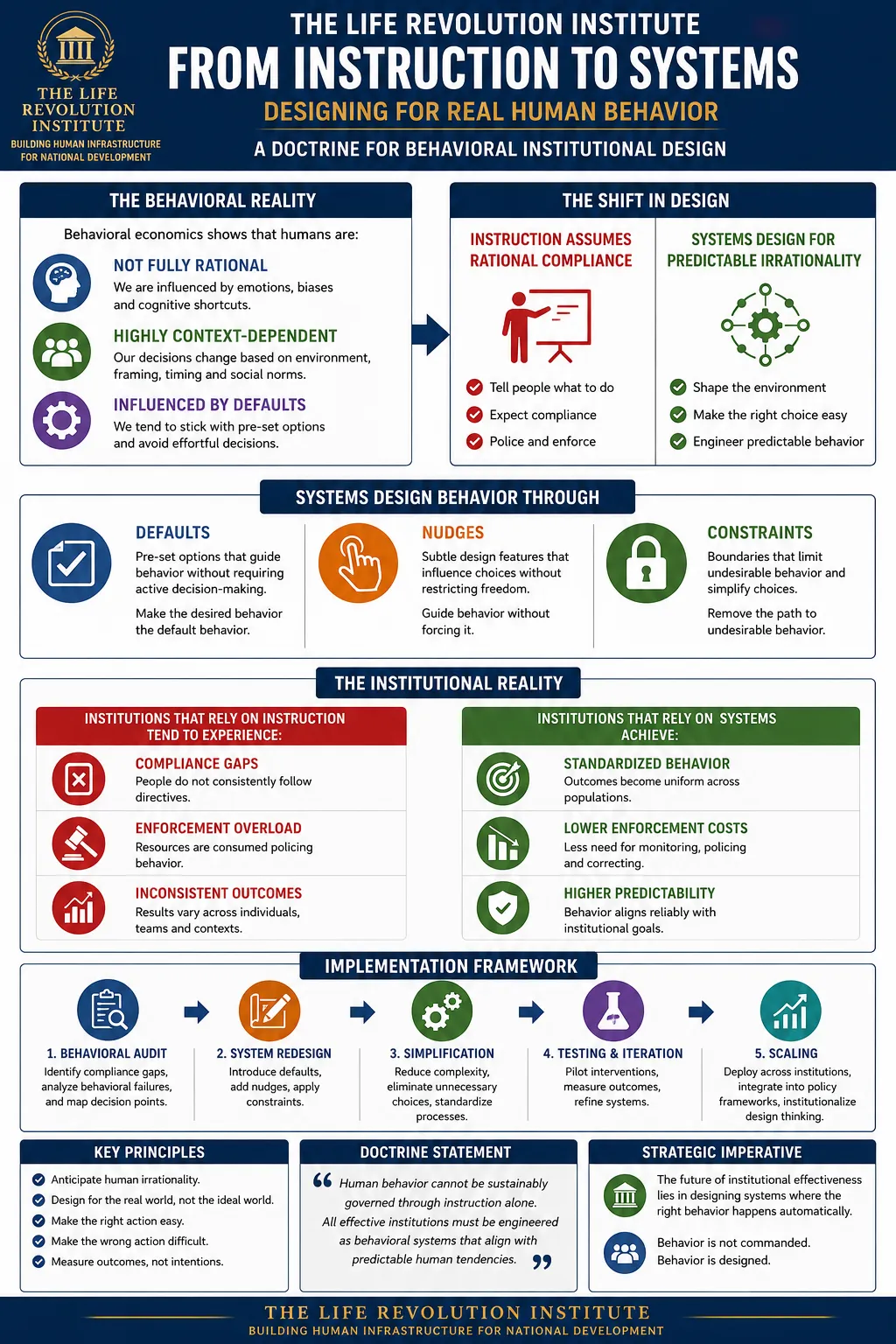
Behavioral economics and cognitive science reveal a very different picture. Humans are:
a. Not Fully Rational
People do not consistently act in their best interests. Decisions are influenced by:
- Emotions
- Cognitive biases
- Social pressures
- Immediate gratification
Examples include procrastination, impulsive spending, unhealthy habits, and poor long-term planning.
b. Highly Context-Dependent
Behavior changes depending on:
- Environment
- Framing of choices
- Social norms
- Timing and mental state
The same individual may act responsibly in one context and irresponsibly in another.
c. Strongly Influenced by Defaults
Humans tend to accept pre-set options rather than actively choosing alternatives. This phenomenon, known as default bias, has profound implications:
- People stick with pre-selected options
- Effort avoidance drives decision-making
- Inertia dominates behavior
This means that whoever sets the default effectively shapes behavior at scale.
1.3 The Implication
If human behavior is:
- Irrational
- Context-driven
- Default-sensitive
Then systems that rely on instruction alone are structurally misaligned with human reality.
This mismatch is the root cause of institutional inefficiency.
Part II: Instruction-Based Systems — Structural Limitations
2.1 The Nature of Instruction-Based Systems
Instruction-based institutions rely on:
- Policies
- Rules
- Guidelines
- Training programs
- Communication campaigns
Their operational logic is:
“If people know what to do, they will do it.”
This logic breaks down in practice.
2.2 The Compliance Gap
Even when instructions are clear:
- People forget
- People delay
- People ignore
- People misunderstand
This creates a compliance gap—the difference between expected behavior and actual behavior.
This gap widens as:
- Complexity increases
- Scale expands
- Monitoring decreases
2.3 Enforcement Overload
To compensate for non-compliance, institutions increase enforcement:
- Monitoring systems
- Supervisory layers
- Penalties and sanctions
- Audits and inspections
This leads to:
- Rising operational costs
- Bureaucratic expansion
- Institutional inefficiency
The system becomes reactive rather than proactive.
2.4 Behavioral Variability
Instruction-based systems produce inconsistent outcomes because:
- Individuals interpret rules differently
- Motivation levels vary
- Contexts differ
- Cognitive biases interfere
This results in:
- Uneven performance
- Unpredictable outputs
- Weak standardization
2.5 The Core Diagnosis
Instruction-based systems fail not because people are unwilling, but because systems are poorly designed.
The problem is not human behavior.
The problem is institutional design.
Part III: System-Based Design — The Behavioral Model
3.1 The Core Principle
System-based design operates on a different premise:
People will behave in predictable ways when environments are structured appropriately.
Instead of telling people what to do, systems shape what people do.
3.2 The Three Mechanisms of Behavioral Design
3.2.1 Defaults
Defaults are pre-selected options that take effect if no alternative is chosen.
Power of Defaults:
- Reduce decision effort
- Exploit inertia
- Increase compliance automatically
Examples:
- Automatic enrollment in programs
- Pre-configured settings
- Default scheduling systems
Principle:
Make the desired behavior the default behavior.
3.2.2 Nudges
Nudges are subtle interventions that influence decisions without restricting freedom.
Characteristics:
- Non-coercive
- Low-cost
- Contextual
Examples:
- Reminders
- Visual cues
- Choice framing
- Social norm messaging
Principle:
Guide behavior without forcing it.
3.2.3 Constraints
Constraints limit undesirable actions and simplify choices.
Types:
- Structural constraints (process design)
- Access restrictions
- Friction for harmful behaviors
Examples:
- Mandatory steps in workflows
- Limited options
- System-enforced requirements
Principle:
Remove the path to undesirable behavior.
3.3 Behavioral Architecture
These three mechanisms combine to form behavioral architecture—the structured environment within which decisions occur.
In a well-designed system:
- Desired actions are easy
- Undesired actions are difficult or impossible
- Behavior becomes automatic
Part IV: Institutional Transformation
4.1 From Instruction to Design
Institutions must transition from:
| Old Model | New Model |
|---|---|
| Rule-based | Design-based |
| Instruction-heavy | System-driven |
| Enforcement-focused | Architecture-focused |
| Reactive | Preventive |
4.2 Designing for Predictable Irrationality
Instead of expecting rational behavior, systems should anticipate:
- Procrastination
- Forgetfulness
- Bias
- Short-term thinking
And design accordingly.
4.3 Embedding Behavior into Systems
Effective institutions:
- Automate compliance
- Reduce decision burden
- Standardize processes
- Eliminate ambiguity
Behavior becomes a function of system design—not individual willpower.
Part V: Sector Applications
5.1 Government
Traditional governance relies on:
- Laws
- Regulations
- Enforcement
Behavioral governance focuses on:
- Process design
- Default policies
- Citizen experience
Outcome:
Higher compliance with lower enforcement cost.
5.2 Education
Traditional education emphasizes:
- Instruction
- Discipline
- Motivation
Behavioral education focuses on:
- Learning environment design
- Habit systems
- Structured engagement
Outcome:
Improved learning consistency.
5.3 Corporate Systems
Traditional management relies on:
- Policies
- Supervision
- Performance pressure
Behavioral organizations design:
- Workflow systems
- Incentive structures
- Decision environments
Outcome:
Higher productivity with less oversight.
5.4 Social Systems
Behavioral design can address:
- Public health
- Financial behavior
- Civic responsibility
By shaping environments rather than issuing instructions.
Part VI: Implementation Framework
6.1 Step 1: Behavioral Audit
- Identify compliance gaps
- Analyze behavioral failures
- Map decision points
6.2 Step 2: System Redesign
- Introduce defaults
- Add nudges
- Apply constraints
6.3 Step 3: Simplification
- Reduce complexity
- Eliminate unnecessary choices
- Standardize processes
6.4 Step 4: Testing and Iteration
- Pilot interventions
- Measure outcomes
- Refine systems
6.5 Step 5: Scaling
- Deploy across institutions
- Integrate into policy frameworks
- Institutionalize design thinking
Part VII: Measurement and Outcomes
7.1 Key Metrics
- Compliance rates
- Behavioral consistency
- Cost of enforcement
- System efficiency
7.2 Expected Results
Institutions that adopt system-based design achieve:
- Predictable outcomes
- Lower operational costs
- Reduced enforcement burden
- Higher efficiency
Part VIII: Doctrine Statement
The Life Revolution Institute formally declares:
Human behavior cannot be sustainably governed through instruction alone.
All effective institutions must be engineered as behavioral systems that align with predictable human tendencies.
Part IX: Strategic Imperative
The shift from instruction to systems is not optional—it is necessary.
Institutions that fail to adapt will experience:
- Increasing inefficiency
- Rising enforcement costs
- Declining effectiveness
Institutions that adapt will achieve:
- Structural efficiency
- Scalable compliance
- Sustainable outcomes
Conclusion
The central question of institutional design is no longer:
“How do we get people to follow instructions?”
The correct question is:
“How do we design systems where the right behavior happens automatically?”
This doctrine provides the answer.
Behavior is not commanded.
Behavior is designed.
Issued by:
The Life Revolution Institute
Building Human Infrastructure for National Development