
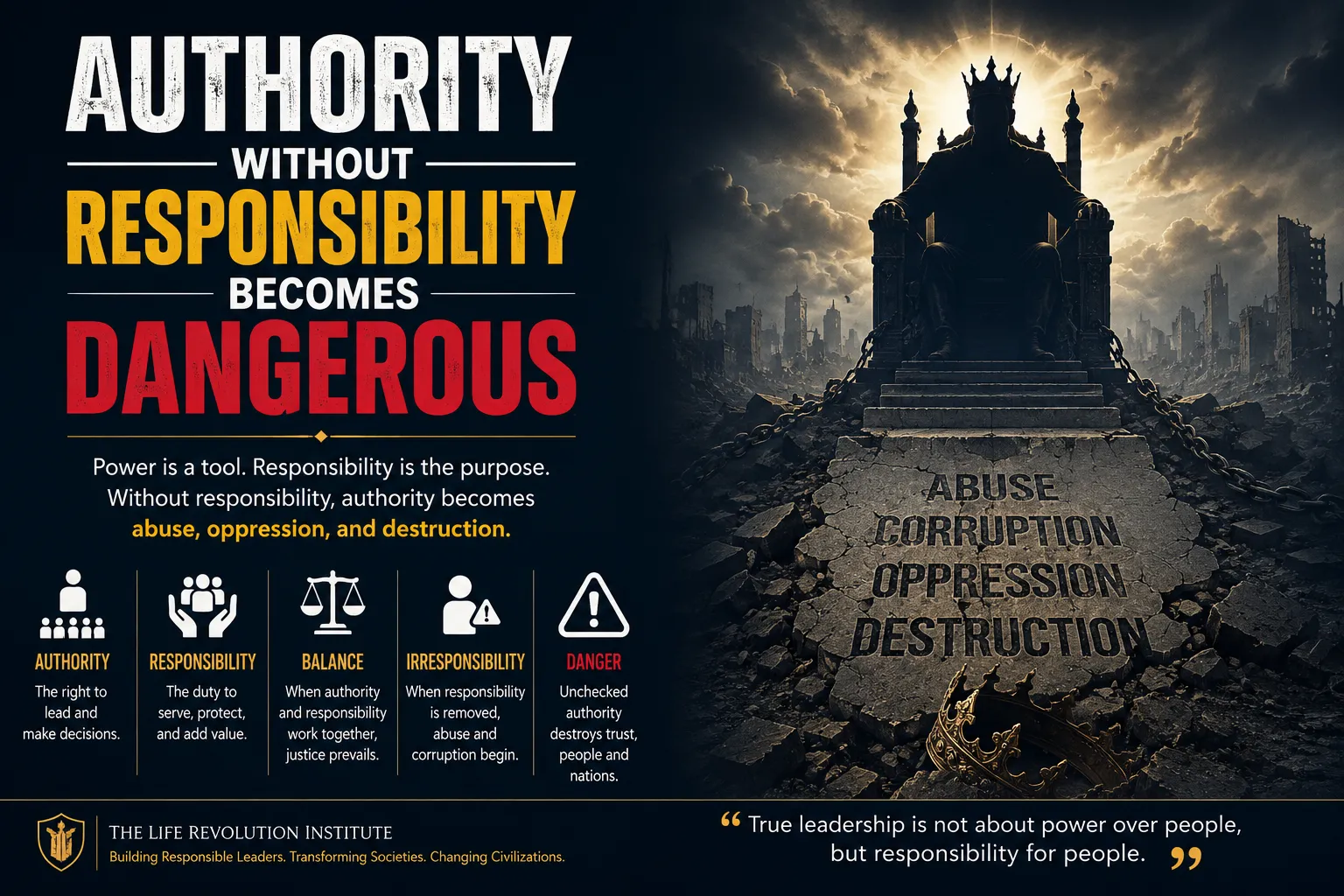
The Moral Law That Must Govern Leadership, Power, Institutions, and Civilization.
The Life Revolution Institute.
Authority gives a person the ability to influence outcomes. Responsibility gives that authority a moral direction. Without responsibility, authority becomes dangerous.
Civilization depends upon authority.
Every functioning society requires people and institutions with the legitimate ability to make decisions, establish standards, allocate resources, enforce rules, protect the vulnerable, settle disputes, coordinate collective action, and make decisions that affect the lives of others.
Parents exercise authority over children. Teachers exercise authority in classrooms. Managers exercise authority in organizations. Judges exercise authority through courts. Police officers exercise authority through law enforcement. Government officials exercise public authority. Business owners exercise economic authority. Religious leaders exercise moral and social influence. Community leaders exercise authority through trust and tradition.
Authority itself is not the problem.
The problem begins when authority becomes separated from responsibility.
When a person possesses the power to influence other people’s lives but does not possess, accept, or practice a corresponding sense of responsibility, authority can become destructive.
That is one of the fundamental laws of institutional life:
Authority without responsibility becomes dangerous.
The greater the authority, the greater the potential consequences of irresponsibility.
A careless individual can damage a household.
A careless teacher can damage a generation of students.
A careless executive can destroy an organization.
A careless political leader can destabilize a nation.
A careless institution can normalize dysfunction across generations.
A careless civilization can use extraordinary technological, economic, military, and political power without possessing the maturity required to govern that power.
The central question of leadership, therefore, is not merely:
“Who has power?”
It is:
“Who can be trusted with power, and what responsibilities must govern its use?”
This distinction is foundational to the philosophy of The Life Revolution Institute.
The Institute’s educational mission is not simply to produce knowledgeable people. It is to develop people capable of responsible action, productive contribution, institutional leadership, and generational stewardship.
Knowledge can increase capability.
Authority can increase influence.
Resources can increase capacity.
Technology can increase reach.
But without responsibility, these advantages can magnify human weakness.
The more powerful the instrument, the more important the character of the person controlling it becomes.
This is why responsibility must precede authority.
1. WHAT IS AUTHORITY?
Authority is the legitimate capacity to make decisions, direct actions, establish standards, allocate resources, or exercise influence within a defined domain.
Authority can come from many sources.
It can come from:
- position;
- law;
- expertise;
- ownership;
- experience;
- institutional appointment;
- social trust;
- reputation;
- wealth;
- knowledge;
- physical capability;
- political mandate;
- organizational hierarchy;
- cultural recognition.
A parent has parental authority.
A principal has institutional authority.
A judge has judicial authority.
A government has political authority.
A business owner has organizational and economic authority.
A teacher has instructional authority.
A coach has developmental authority.
A military commander has operational authority.
Authority therefore is not inherently oppressive.
Properly structured authority is one of civilization’s greatest inventions.
Without authority, collective action becomes difficult.
Someone must decide.
Someone must coordinate.
Someone must establish boundaries.
Someone must enforce standards.
Someone must accept accountability for outcomes.
A family without responsible parental authority can become unstable.
A classroom without legitimate educational authority can become chaotic.
An organization without decision-making authority can become paralyzed.
A government without legitimate authority cannot effectively maintain public order.
Therefore, the objective cannot be to eliminate authority.
The objective is to civilize authority.
Civilized authority is authority constrained by responsibility, law, ethics, competence, accountability, and purpose.
2. AUTHORITY IS A MULTIPLIER
Authority does not automatically make a person better.
It makes a person’s decisions more consequential.
This distinction is essential.
If a person has little authority, their mistakes may affect only a small number of people.
If that same person receives greater authority, the consequences of the same behavioral weaknesses become larger.
Authority therefore acts as a multiplier.
A disciplined person with authority can create stability.
An irresponsible person with authority can create instability.
A wise person with authority can build institutions.
A selfish person with authority can exploit institutions.
A competent person with authority can solve problems.
An incompetent person with authority can institutionalize problems.
A responsible person can use authority to protect others.
An irresponsible person can use authority to protect themselves at the expense of others.
The authority itself may be neutral.
The character, competence, incentives, values, and accountability mechanisms surrounding that authority determine how it is used.
This produces a critical institutional equation:
Authority × Character × Competence × Accountability = Institutional Impact
If authority is high but character and accountability are low, the potential for harm increases.
If authority is high and responsibility is high, the potential for constructive impact increases.
This is why civilizations cannot afford to educate people only for acquisition of authority.
They must educate people for stewardship of authority.
3. RESPONSIBILITY IS THE MORAL COUNTERWEIGHT TO AUTHORITY
Responsibility means accepting ownership for one’s choices, duties, consequences, obligations, and impact on others.
Responsibility asks questions that authority alone does not ask.
Authority asks:
“What can I decide?”
Responsibility asks:
“What should I decide?”
Authority asks:
“What can I control?”
Responsibility asks:
“What am I obligated to protect?”
Authority asks:
“What can I make others do?”
Responsibility asks:
“What example am I setting?”
Authority asks:
“Who reports to me?”
Responsibility asks:
“To whom am I accountable?”
Authority asks:
“What are my rights?”
Responsibility asks:
“What are my duties?”
Mature leadership requires both.
Authority without responsibility produces domination.
Responsibility without authority can produce helplessness.
But when authority and responsibility are properly aligned, leadership becomes constructive.
That alignment is one of the most important principles of institutional design.
4. THE DANGER OF POWER WITHOUT CONSEQUENCES
One of the greatest threats created by authority is the separation between decision-making and consequences.
When people experience the consequences of their own decisions, reality provides feedback.
If someone wastes their own money, they experience financial consequences.
If someone neglects their own responsibilities, they experience personal consequences.
But when a person can make decisions that affect others while avoiding the consequences of those decisions, a dangerous condition emerges.
The decision-maker becomes insulated from reality.
This creates what may be called consequence separation.
The person making the decision does not experience the cost.
Other people do.
A leader makes a poor decision.
Employees suffer.
A policymaker creates a defective policy.
Citizens suffer.
An executive mismanages resources.
Workers lose opportunities.
A parent behaves irresponsibly.
Children carry the consequences.
An institution ignores corruption.
Future generations inherit the damage.
The farther authority becomes separated from consequence, the greater the need for accountability.
This is why responsible systems create mechanisms that reconnect authority with consequences.
Audits.
Reviews.
Elections.
Performance measurements.
Legal oversight.
Professional standards.
Independent investigations.
Financial controls.
Transparent reporting.
Public scrutiny.
These mechanisms are not necessarily attacks on authority.
They are mechanisms for protecting authority from becoming irresponsible.
5. AUTHORITY WITHOUT ACCOUNTABILITY
Authority and accountability must operate together.
Accountability means that a person entrusted with authority must be answerable for how that authority is exercised.
A leader who can make decisions but cannot be questioned is vulnerable to corruption.
A leader who can allocate resources but cannot be audited is vulnerable to abuse.
A leader who can discipline others but cannot be evaluated is vulnerable to hypocrisy.
A leader who can establish standards but is exempt from those standards is vulnerable to authoritarianism.
Accountability therefore establishes a boundary around authority.
It says:
You have the right to exercise this power, but you do not own the consequences of everyone else.
You are a steward.
You are entrusted.
You are answerable.
This concept of stewardship is fundamental.
A steward does not treat entrusted resources as personal property.
A steward protects what has been entrusted.
A steward improves it.
A steward documents decisions.
A steward prepares successors.
A steward thinks beyond personal gain.
A steward asks:
“What condition will this institution be in when I leave?”
That is the difference between leadership and possession.
6. AUTHORITY IS A TRUST
Authority should be understood as a trust rather than merely a privilege.
When a person receives authority, society is effectively saying:
“We are allowing you to exercise power within this domain because we believe you can use it responsibly.”
That trust can come through different mechanisms.
Parents are entrusted with children.
Teachers are entrusted with students.
Executives are entrusted with organizations.
Public officials are entrusted with public resources.
Judges are entrusted with judicial authority.
Professionals are entrusted with specialized responsibilities.
Community leaders are entrusted with social influence.
The legitimacy of authority therefore depends partly upon trust.
When authority is abused repeatedly, trust deteriorates.
And when trust deteriorates, institutions weaken.
This creates a long-term institutional cycle:
Trust → Authority → Responsibility → Accountability → Performance → Greater Trust
But there is also a destructive cycle:
Trust → Authority → Abuse → Distrust → Resistance → Institutional Weakness
Civilization must therefore build systems that reinforce the first cycle and interrupt the second.
7. THE FIRST RESPONSIBILITY OF AUTHORITY IS SELF-GOVERNMENT
Before a person governs others, that person must learn to govern themselves.
This is one of the deepest principles of leadership.
Self-government includes:
- emotional regulation;
- discipline;
- honesty;
- delayed gratification;
- integrity;
- intellectual humility;
- responsible decision-making;
- respect for boundaries;
- consistency;
- accountability.
A person who cannot govern their impulses should not be trusted with extensive authority.
A person who cannot manage money responsibly should not casually control large financial resources.
A person who cannot control anger should not be placed in situations where anger determines institutional decisions.
A person who cannot accept correction will eventually misuse authority.
A person who cannot distinguish personal preference from institutional duty will corrupt decision-making.
This does not mean leaders must be perfect.
No human being is perfect.
It means leadership requires the capacity to recognize weaknesses, establish safeguards, accept correction, and continuously develop.
The first institution every leader must govern is themselves.
Self-mastery is the foundation of responsible authority.
8. THE FAMILY: WHERE AUTHORITY BEGINS
The family is one of the first environments in which human beings encounter authority.
Parents exercise authority because children require protection, education, boundaries, guidance, and development.
But parental authority is not ownership.
Children are not possessions.
They are developing human beings entrusted to parental care.
Therefore, parental authority should be understood as developmental stewardship.
The purpose of parental authority is not simply obedience.
It is development.
A responsible parent gradually transfers responsibility to the child.
The objective is not to create permanent dependence.
The objective is to produce capable adults.
This means authority must evolve.
Early childhood requires greater external control.
Adolescence requires increasing responsibility.
Adulthood requires self-government.
A parent who refuses to transfer responsibility may create dependence.
A parent who transfers responsibility without preparation may create instability.
Responsible authority therefore asks:
“What does this person need to become capable of governing themselves?”
That question transforms authority from control into development.
9. EDUCATION: AUTHORITY MUST PRODUCE CAPABILITY
The classroom is another environment where authority can easily be misunderstood.
A teacher has authority.
But the purpose of that authority is not simply to produce obedience.
It is to develop competence.
The teacher’s authority should create an environment where students learn to think, question, investigate, reason, communicate, solve problems, collaborate, and act responsibly.
Education therefore has a paradox:
The successful educator uses authority to make the learner progressively less dependent upon authority.
A student should not need a teacher forever.
The teacher’s goal is to transfer capability.
The institution should therefore measure educational success not merely by information transferred but by responsibility developed.
This is why The Life Revolution Institute emphasizes the development of people capable of:
Responsible action.
Productive contribution.
Institutional leadership.
Generational stewardship.
Education becomes transformative when knowledge becomes capacity and capacity becomes responsible action.
10. ORGANIZATIONS: THE DANGER OF HIERARCHY WITHOUT ACCOUNTABILITY
Organizations require hierarchy.
Someone must have final authority.
However, hierarchy creates risks when authority becomes disconnected from accountability.
A manager can intimidate employees.
An executive can misuse company resources.
A founder can confuse personal identity with institutional identity.
A department head can protect poor performers because of personal loyalty.
A senior employee can suppress information because junior employees fear retaliation.
These are not merely personality problems.
They are system-design problems.
Healthy organizations therefore distribute accountability.
Authority should be accompanied by:
- clearly defined responsibilities;
- measurable objectives;
- reporting structures;
- financial controls;
- conflict-of-interest policies;
- performance reviews;
- documentation;
- grievance procedures;
- succession planning;
- ethical standards.
The goal is not to prevent leaders from leading.
The goal is to ensure that leadership remains compatible with institutional health.
11. GOVERNMENT: THE HIGHEST STAKES OF PUBLIC AUTHORITY
Public authority carries extraordinary responsibility because government decisions can affect millions of people.
Governments control or influence:
- laws;
- public resources;
- infrastructure;
- education;
- health systems;
- taxation;
- security;
- economic policy;
- environmental regulation;
- public institutions.
This makes responsible government essential.
Political authority must never become a personal entitlement.
Public office is stewardship.
A public official is not the owner of public resources.
A government leader is not the owner of citizens.
Political power exists within a constitutional, legal, and institutional framework.
The legitimacy of public authority depends upon the principle that power must be exercised for public purposes and subject to lawful constraints.
When public authority becomes personal property, institutions begin to deteriorate.
The language changes.
Instead of:
“The state exists to serve the citizen.”
The system begins to operate as:
“The citizen exists to serve the state.”
That reversal is dangerous.
Responsible public leadership must therefore preserve the distinction between office and person.
The office belongs to the institution.
The individual temporarily occupies the office.
This principle is central to institutional continuity.
12. THE MOST DANGEROUS SENTENCE IN LEADERSHIP
One of the most dangerous ideas a leader can adopt is:
“I am the institution.”
No individual is the institution.
A founder is not the organization.
A president is not the state.
A principal is not the school.
A chief executive is not the company.
A pastor is not the entire congregation.
A director is not the mission.
When personal identity becomes fused with institutional authority, criticism can begin to feel like personal betrayal.
This makes correction difficult.
The leader may interpret accountability as disrespect.
Opposition becomes disloyalty.
Questions become rebellion.
Transparency becomes threatening.
Succession becomes unimaginable.
This is how institutions become dependent upon personalities.
Strong institutions must survive strong personalities.
Indeed, one of the greatest tests of leadership is whether the institution can remain healthy after the leader leaves.
13. RESPONSIBILITY REQUIRES RESTRAINT
Not everything a person has the authority to do should be done.
This is an important distinction.
Legality is not identical to wisdom.
Capability is not identical to responsibility.
Authority is not identical to permission.
A leader may have the legal ability to make a decision and still have a moral responsibility to exercise restraint.
Restraint is therefore a form of strength.
Weak authority asks:
“Can I?”
Mature authority asks:
“Should I?”
The ability to refrain from using power is itself evidence of self-government.
The strongest leaders are not necessarily those who demonstrate the most power.
Often they are those who possess significant power but use it carefully.
14. RESPONSIBILITY CREATES BOUNDARIES
Every legitimate authority requires boundaries.
A teacher’s authority has boundaries.
A manager’s authority has boundaries.
A parent has boundaries.
A government has boundaries.
A business has boundaries.
A professional has boundaries.
Boundaries answer the question:
“Where does this authority stop?”
Without boundaries, authority tends toward expansion.
Authority naturally seeks to solve problems.
That can become dangerous when every problem is interpreted as justification for greater control.
Responsible systems therefore define jurisdiction.
Who decides?
What can they decide?
Under what conditions?
For how long?
According to what standards?
Subject to whose review?
With what appeal mechanism?
With what consequences for abuse?
These questions are not bureaucratic distractions.
They are architecture for responsible power.
15. THE PROBLEM OF UNCHECKED AUTHORITY
Unchecked authority tends to create three major risks.
15.1 Corruption
When authority produces benefits without sufficient accountability, people may begin using public or institutional power for private advantage.
15.2 Arrogance
Repeated obedience from others can cause leaders to overestimate their own judgment.
15.3 Detachment
Leaders may become increasingly disconnected from the realities experienced by the people affected by their decisions.
These risks reinforce one another.
Authority produces obedience.
Obedience produces confidence.
Confidence without correction can produce overconfidence.
Overconfidence can produce detachment.
Detachment can produce harmful decisions.
Harmful decisions can produce institutional decline.
Therefore, responsible institutions deliberately create mechanisms for feedback.
16. FEEDBACK IS A SAFETY SYSTEM
A healthy institution needs truth to travel upward.
Employees must be able to tell leaders what is happening.
Students must be able to raise legitimate concerns.
Citizens must be able to challenge government decisions through lawful mechanisms.
Board members must be able to question executives.
Managers must be able to challenge assumptions.
Organizations that punish all disagreement eventually become blind.
This creates a fundamental principle:
Authority must never become so powerful that truth becomes afraid to approach it.
Leaders need uncomfortable information.
They need criticism.
They need alternative perspectives.
They need performance data.
They need independent evaluation.
They need people willing to say:
“This is not working.”
Responsible authority does not eliminate disagreement.
It creates a system capable of processing disagreement productively.
17. POWER SHOULD BE DESIGNED FOR STEWARDSHIP
The word “power” often carries negative associations because people have repeatedly experienced its abuse.
But power itself is simply the capacity to produce effects.
The question is:
What effects are being produced?
Power can build.
Power can protect.
Power can educate.
Power can create opportunity.
Power can establish order.
Power can also exploit.
Power can suppress.
Power can manipulate.
Power can destroy.
Therefore, the objective is not merely to distribute power.
It is to develop people capable of stewarding power.
This is why capacity-building must precede institutional authority.
Before giving someone responsibility for others, develop their capacity to handle responsibility.
Before expanding authority, expand competence.
Before increasing reach, strengthen character.
Before increasing resources, strengthen stewardship.
Before increasing power, strengthen accountability.
18. AUTHORITY AND CHARACTER
Competence matters.
But competence without character can become dangerous.
A highly competent dishonest person can cause more damage than an incompetent dishonest person.
Why?
Because competence increases execution capacity.
This produces an important principle:
Character determines direction; competence determines execution.
You need both.
Character without competence can produce good intentions with poor results.
Competence without character can produce excellent execution toward destructive objectives.
Responsible leadership requires:
Character + Competence + Accountability + Purpose.
These elements should reinforce one another.
19. THE AUTHORITY LADDER
Authority can be understood as developing through stages.
Level 1: Personal Authority
The ability to govern oneself.
Level 2: Relational Authority
The ability to influence relationships responsibly.
Level 3: Functional Authority
The ability to perform a role effectively.
Level 4: Organizational Authority
The ability to coordinate people and resources.
Level 5: Institutional Authority
The ability to shape systems and standards.
Level 6: Societal Authority
The ability to influence communities and public systems.
Level 7: Generational Authority
The ability to create structures whose effects extend beyond one’s lifetime.
The higher the level, the greater the responsibility.
A person who wants greater influence must therefore accept greater stewardship.
This is why leadership development cannot stop at personal success.
The progression should be:
Self → Family → Organization → Institution → Society → Generation.
20. THE RESPONSIBILITY ESCALATION PRINCIPLE
A simple rule should govern the expansion of authority:
As authority increases, responsibility must increase faster.
Why faster?
Because the consequences of failure become larger.
A person managing themselves can make a mistake.
A person managing ten people can affect ten lives.
A person managing a thousand people can affect hundreds or thousands of livelihoods.
A public leader can affect millions.
A civilization with advanced technology can affect the future of humanity.
Therefore:
Greater authority requires greater maturity.
The problem occurs when authority expands faster than responsibility.
This creates a dangerous imbalance:
Authority > Responsibility
The result may be abuse.
A healthier condition is:
Responsibility ≥ Authority
The leader’s sense of duty must be at least equal to the power entrusted to them.
21. THE RESPONSIBILITY REVOLUTION
This principle connects directly to the broader philosophy of The Life Revolution Institute.
Societies frequently demand rights without equally emphasizing duties.
Organizations demand performance without sufficiently developing accountability.
Individuals demand opportunity without accepting responsibility.
Leaders demand loyalty without demonstrating stewardship.
Citizens demand government benefits without always considering civic obligations.
Parents demand obedience without always modeling discipline.
Employees demand leadership without always accepting responsibility for outcomes.
A mature society must restore balance.
Rights matter.
Freedom matters.
Opportunity matters.
Authority matters.
But all of these must operate alongside responsibility.
This is the foundation of a Responsibility Revolution.
The Responsibility Revolution is not a campaign for punishment.
It is a cultural movement toward ownership.
Ownership of choices.
Ownership of consequences.
Ownership of duties.
Ownership of institutions.
Ownership of the future.
22. RESPONSIBILITY IS NOT BLAME
Responsibility should not be confused with blame.
Blame asks:
“Whose fault is this?”
Responsibility asks:
“What must be done now?”
Blame looks backward.
Responsibility looks backward enough to understand causes and forward enough to create solutions.
This distinction matters in institutional leadership.
A responsible leader does not spend all their energy identifying someone to punish.
They ask:
- What happened?
- Why did it happen?
- What conditions enabled it?
- What failed?
- What must be repaired?
- What controls are needed?
- What lesson must be institutionalized?
This turns failure into institutional learning.
23. RESPONSIBILITY AND CONSEQUENCES
Responsibility also means accepting consequences.
A leader cannot demand responsibility from others while avoiding it personally.
If employees are punished for mistakes while executives are protected from theirs, the organization learns hypocrisy.
If students are expected to meet deadlines while teachers routinely ignore theirs, the educational culture weakens.
If citizens are expected to obey laws while officials operate above the law, legitimacy deteriorates.
Therefore:
The standards imposed upon others must also govern the authority that imposes them.
This is one of the foundations of moral credibility.
24. THE LEADER AS STANDARD-BEARER
Leadership is not merely the ability to give instructions.
Leadership is the ability to embody standards.
People observe what leaders do.
They learn from what leaders tolerate.
They learn from what leaders reward.
They learn from what leaders punish.
They learn from what leaders ignore.
They learn from how leaders respond to mistakes.
They learn from how leaders treat people with less power.
This produces an important institutional principle:
Culture is often the behavior of authority repeated throughout the system.
If leaders are disciplined, discipline becomes credible.
If leaders are careless, rules become performative.
If leaders are accountable, accountability becomes normal.
If leaders manipulate information, organizational truth becomes compromised.
Therefore, responsible authority is pedagogical.
Leaders teach even when they are not teaching.
25. AUTHORITY AND THE VULNERABLE
One of the clearest tests of responsible authority is how power treats people with less power.
A leader’s character is revealed not only by how they treat equals or superiors but also by how they treat people who cannot easily challenge them.
This includes:
- children;
- students;
- junior employees;
- vulnerable citizens;
- people with fewer resources;
- newcomers;
- people dependent upon institutional decisions.
Responsible authority protects legitimate vulnerability.
It does not exploit dependency.
This principle should be built into institutional design.
Where there is significant power imbalance, stronger safeguards are often required.
26. TECHNOLOGY MAKES THIS PRINCIPLE MORE IMPORTANT
Modern technology has expanded human authority dramatically.
One person can now communicate with millions.
One organization can collect enormous amounts of information.
Artificial intelligence can amplify decision-making.
Digital platforms can influence public opinion.
Financial systems can move resources globally.
Scientific technologies can produce capabilities unimaginable to previous generations.
This creates an unprecedented challenge.
Human capability is increasing rapidly.
But capability does not automatically produce wisdom.
Technology amplifies human intentions.
If responsibility increases alongside capability, technology can produce extraordinary progress.
If responsibility fails to keep pace, technology can magnify human irresponsibility.
Therefore:
The more powerful our tools become, the more important human responsibility becomes.
The future will not merely be determined by what humanity can do.
It will be determined by whether humanity develops the wisdom to decide what should be done.
27. INSTITUTIONS MUST OUTLIVE PERSONALITIES
A responsible leader thinks beyond personal achievement.
The question is not:
“How powerful can I become?”
The better question is:
“What can I build that remains useful after I am gone?”
This is the difference between personal power and institutional legacy.
Personal power ends when the individual leaves.
Institutional capacity can continue.
A responsible leader therefore builds:
- systems;
- processes;
- standards;
- documentation;
- training;
- leadership pipelines;
- succession plans;
- financial controls;
- institutional memory;
- governance structures.
This is stewardship.
The leader becomes less important because the institution becomes stronger.
That is success.
28. SUCCESSION IS A RESPONSIBILITY
One of the clearest indicators of responsible authority is preparation for succession.
An irresponsible leader asks:
“How can I remain indispensable?”
A responsible leader asks:
“How can I make the institution capable without me?”
This requires developing successors.
It requires transferring knowledge.
It requires documenting processes.
It requires allowing others to lead.
It requires creating systems that do not depend upon one person’s memory.
The ultimate test of institutional leadership is not whether the organization succeeds while you are present.
It is whether it remains capable after you leave.
29. RESPONSIBILITY AND LEGACY
Legacy is often misunderstood as fame.
But legacy is not primarily about being remembered.
Legacy is about what continues because you were responsible enough to build it.
A person may leave behind:
- a stronger family;
- capable children;
- trained leaders;
- ethical institutions;
- educational systems;
- businesses;
- infrastructure;
- ideas;
- knowledge;
- standards;
- culture.
This is generational responsibility.
The mature leader understands:
I am not merely living for my moment. I am participating in a chain of generations.
This changes decision-making.
Short-term gratification becomes less important.
Institutional durability becomes more important.
Reputation becomes less important than substance.
Personal control becomes less important than continuity.
30. THE INSTITUTIONAL RESPONSIBILITY FORMULA
The Life Revolution Institute can express this principle through a practical framework:
Authority + Responsibility + Competence + Accountability + Purpose = Responsible Leadership
Remove responsibility:
Authority + Competence = Potentially Efficient Abuse
Remove competence:
Authority + Responsibility = Good Intentions Without Adequate Capacity
Remove accountability:
Authority + Responsibility + Competence = Vulnerability to Unchecked Power
Remove purpose:
Authority + Responsibility + Competence + Accountability = Efficient but Potentially Misaligned Leadership
All five matter.
Responsible authority is therefore not a single trait.
It is a system.
31. HOW TO BUILD RESPONSIBLE AUTHORITY
Institutions seeking responsible leadership should develop five layers.
Layer One: Character
Develop:
- integrity;
- humility;
- discipline;
- courage;
- honesty;
- emotional maturity.
Layer Two: Competence
Develop:
- knowledge;
- technical skills;
- decision-making;
- communication;
- strategic thinking;
- problem-solving.
Layer Three: Responsibility
Teach people to:
- own outcomes;
- meet obligations;
- manage resources;
- protect people;
- consider consequences.
Layer Four: Accountability
Create:
- audits;
- evaluations;
- reporting systems;
- feedback mechanisms;
- oversight;
- consequences.
Layer Five: Stewardship
Teach leaders to:
- preserve institutions;
- develop successors;
- document knowledge;
- protect resources;
- think generationally.
This produces a leadership architecture rather than merely a leadership personality.
32. QUESTIONS EVERY PERSON WITH AUTHORITY SHOULD ASK
Before exercising authority, leaders should ask:
- What authority has been entrusted to me?
- What responsibilities accompany it?
- Who will be affected by my decision?
- What are the possible consequences?
- What information am I missing?
- Who should challenge my assumptions?
- What boundaries apply to my authority?
- How will this decision be evaluated?
- What happens if I am wrong?
- What precedent am I creating?
- Does this strengthen or weaken the institution?
- Will this decision still make sense five years from now?
- What will happen after I leave?
- Am I protecting the mission or protecting myself?
- Am I using power for stewardship or personal advantage?
These questions transform authority from impulse into deliberation.
33. A CULTURE OF RESPONSIBLE AUTHORITY
A healthy society must teach responsibility before celebrating power.
Children should learn that leadership means service.
Students should learn that influence creates obligation.
Young professionals should learn that promotion means greater accountability, not merely greater privilege.
Executives should understand that corporate authority carries responsibilities toward employees, customers, communities, and institutional continuity.
Public officials should understand that public office is stewardship.
Citizens should understand that freedom requires responsibility.
Families should understand that parental authority exists for development.
This is how responsibility becomes cultural rather than merely procedural.
34. THE FIVE TESTS OF RESPONSIBLE AUTHORITY
Any authority structure can be evaluated using five tests.
Test One: Purpose
Why does this authority exist?
Test Two: Competence
Does the person possess the ability to exercise it properly?
Test Three: Boundaries
Where does the authority stop?
Test Four: Accountability
Who can review or challenge its exercise?
Test Five: Continuity
Does the use of authority strengthen the institution for the future?
If an authority structure repeatedly fails these tests, institutional reform may be necessary.
35. AUTHORITY SHOULD CREATE MORE RESPONSIBLE PEOPLE
The highest form of leadership does not merely produce followers.
It produces responsible leaders.
A parent should develop capable adults.
A teacher should develop independent thinkers.
A manager should develop future managers.
An executive should develop future executives.
A government should develop citizens capable of responsible participation.
An institute should develop people capable of building institutions.
This is leadership as multiplication.
The leader’s impact therefore becomes:
Authority → Development → Capability → Responsibility → New Leadership
This is how generations advance.
36. THE CIVILIZATIONAL PRINCIPLE
Civilization advances when human power becomes increasingly governed by human responsibility.
Primitive systems often rely heavily on force.
Developing systems rely increasingly on law.
Mature systems require law, institutions, norms, education, accountability, and culture.
The ultimate objective is not simply to increase human power.
It is to increase the capacity to govern that power.
This is one of the central challenges of civilization.
Humanity can create more powerful technologies.
But can humanity create more responsible institutions?
Humanity can produce more wealth.
But can humanity develop better stewards of wealth?
Humanity can expand political influence.
But can humanity produce leaders capable of restraining themselves?
Humanity can accumulate knowledge.
But can humanity develop wisdom?
These questions will define the future.
37. FROM AUTHORITY TO STEWARDSHIP
The progression should therefore be:
Power → Authority → Responsibility → Accountability → Stewardship
Power is capacity.
Authority is legitimate power.
Responsibility is obligation.
Accountability is answerability.
Stewardship is long-term care.
The final objective is stewardship.
A person who merely wants power asks:
“What can I control?”
A person who seeks authority asks:
“What can I decide?”
A responsible leader asks:
“What am I obligated to do?”
An accountable leader asks:
“How will my decisions be evaluated?”
A steward asks:
“What condition will I leave behind?”
That final question represents mature leadership.
38. THE LIFE REVOLUTION INSTITUTE DOCTRINE
The Life Revolution Institute should therefore teach the following doctrine:
Authority is not a reward for achievement. It is a responsibility proportional to influence.
Authority should never be separated from accountability.
Leadership should never be separated from stewardship.
Power should never be separated from purpose.
Rights should never be separated from duties.
Opportunity should never be separated from responsibility.
Education should never be separated from character.
And institutional leadership should never be separated from generational thinking.
The Institute’s educational objective is therefore not merely to create successful individuals.
It is to create responsible individuals capable of using success to build stronger families, organizations, communities, institutions, and societies.
39. THE RESPONSIBLE AUTHORITY COVENANT
Every person entrusted with meaningful authority should be able to affirm:
I recognize that authority is entrusted to me, not owned by me.
I will exercise authority within defined boundaries.
I will accept responsibility for the consequences of my decisions.
I will remain accountable to legitimate oversight.
I will not confuse personal interest with institutional purpose.
I will seek truth even when truth challenges me.
I will develop the people entrusted to my leadership.
I will protect those who are legitimately dependent upon my decisions.
I will use resources as a steward rather than an owner.
I will prepare successors rather than create dependence.
I will strengthen institutions rather than build personality cults around myself.
I will measure leadership by the quality of what continues after me.
I will remember that greater authority creates greater responsibility.
I will use power to build, protect, develop, and preserve.
I will leave the institution, community, and generation stronger than I found them.
This covenant expresses the moral architecture of responsible authority.
40. CONCLUSION: POWER MUST BECOME STEWARDSHIP
Authority is unavoidable.
Every family has it.
Every school has it.
Every organization has it.
Every government has it.
Every institution has it.
The question is therefore not whether authority will exist.
The question is what will govern it.
Authority governed by selfishness becomes exploitation.
Authority governed by fear becomes oppression.
Authority governed by incompetence becomes dysfunction.
Authority governed by ego becomes authoritarianism.
Authority governed by responsibility becomes stewardship.
That is the transformation civilization requires.
We must stop teaching people merely how to acquire authority.
We must teach them how to carry it.
We must stop celebrating power without examining character.
We must stop promoting people merely because they are ambitious.
We must stop confusing confidence with competence.
We must stop confusing position with leadership.
We must stop confusing obedience with institutional health.
And we must stop assuming that giving someone power automatically makes them capable of using it.
Authority must be earned through character, strengthened through competence, constrained through accountability, and directed toward stewardship.
The greater the authority, the greater the responsibility.
The greater the influence, the greater the obligation.
The greater the power, the greater the need for self-government.
The greater the institution, the greater the duty to preserve it.
And the greater the impact across generations, the greater the responsibility to think beyond oneself.
This is the law:
AUTHORITY WITHOUT RESPONSIBILITY BECOMES DANGEROUS.
But authority governed by responsibility can become one of civilization’s greatest constructive forces.
It can protect.
It can educate.
It can organize.
It can build.
It can develop.
It can preserve.
It can create opportunity.
It can establish order.
It can transfer wisdom.
It can prepare generations.
It can build institutions that outlive individuals.
That is the standard.
Not:
“How much authority do I possess?”
But:
“How responsibly can I carry the authority entrusted to me?”
Not:
“How many people can I control?”
But:
“How many people can I develop into responsible leaders?”
Not:
“How much power can I accumulate?”
But:
“How much good can I responsibly build with the power I have?”
And ultimately:
“What will remain stronger because I was entrusted with authority?”
That is the difference between power and leadership.
That is the difference between control and stewardship.
That is the difference between personal success and institutional legacy.
And that is the foundation upon which a responsible civilization must be built.
THE LIFE REVOLUTION INSTITUTE — CORE PRINCIPLE
Authority must never grow faster than responsibility.
Authority gives capacity.
Responsibility gives direction.
Accountability gives restraint.
Competence gives effectiveness.
Purpose gives meaning.
Stewardship gives continuity.
Authority + Responsibility + Competence + Accountability + Purpose = Responsible Leadership
Ideas change minds.
Movements change generations.
Institutions change civilizations.
The Life Revolution Institute
Teaching the Laws That Govern Life Outcomes.