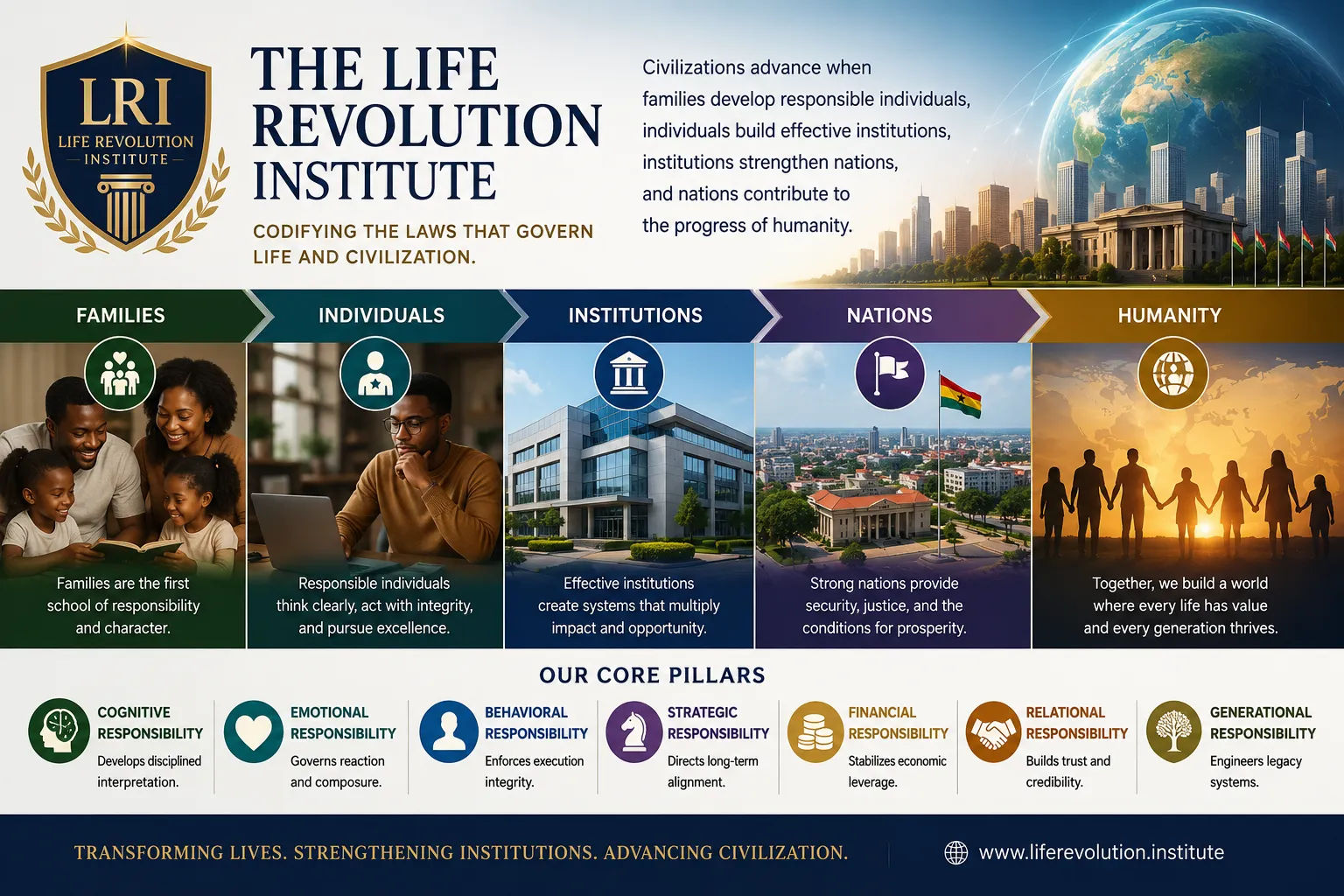
Civilizations Advance When Families Develop Responsible Individuals, Individuals Build Effective Institutions, Institutions Strengthen Nations, and Nations Contribute to the Progress of Humanity
Codifying the Principles That Govern Life and Civilization
Introduction
Every civilization leaves behind evidence of what it valued most. Some leave monuments. Others leave philosophies, constitutions, technologies, universities, or systems of governance. Yet beneath every enduring civilization lies something even more fundamental—a culture of responsibility.
History repeatedly demonstrates that civilizations do not collapse primarily because of external enemies. They weaken internally when responsibility declines, character erodes, institutions become ineffective, and leadership loses integrity.
The Life Revolution Institute exists because civilization itself depends upon understanding and cultivating these foundational principles.
Our central proposition is straightforward:
Civilizations advance when families develop responsible individuals, individuals build effective institutions, institutions strengthen nations, and nations contribute to the progress of humanity.
This statement describes a complete system of civilization development. It explains how personal transformation becomes social transformation and how private responsibility becomes public prosperity.
Civilization Is Built from the Inside Out
Many development models begin with economics or politics. The Life Revolution Institute begins somewhere much earlier.
Civilization begins with human beings.
Economic systems are designed by people.
Governments are operated by people.
Businesses are led by people.
Schools educate people.
Communities are shaped by people.
Technology reflects the values of people.
If people lack discipline, integrity, wisdom, and responsibility, no political system can permanently compensate.
Therefore, the most important infrastructure in any nation is not roads, ports, airports, or digital networks.
The primary infrastructure of civilization is human capability.
Everything else rests upon it.
The Family: Civilization’s First Institution
Every child enters civilization through a family.
Long before formal education, government policy, or workplace culture, families shape the first understanding of responsibility.
Families teach:
- trust
- discipline
- honesty
- respect
- cooperation
- resilience
- accountability
- stewardship
Healthy families produce emotionally secure individuals.
Responsible families cultivate future leaders.
Strong families reduce social instability.
Families are therefore not merely private units; they are civilization’s first institution.
When families deteriorate, societies spend enormous resources repairing problems that could have been prevented through healthy formation.
Crime, corruption, violence, addiction, educational failure, and social fragmentation often trace their roots to weakened family systems.
The Life Revolution Institute views family development not as a social preference but as a strategic investment in national capacity.
Responsible Individuals: The Foundation of Every Great Society
Families exist for a purpose beyond survival.
Their highest contribution is developing responsible individuals.
Responsibility is the capacity to intentionally govern one’s thoughts, emotions, behavior, decisions, relationships, finances, and future.
Responsible individuals do not merely avoid problems.
They create value.
They solve problems.
They improve systems.
They inspire trust.
They finish what they begin.
They understand that freedom without responsibility eventually becomes disorder.
Responsibility therefore becomes the engine of civilization.
The Life Revolution Institute teaches responsibility across seven interconnected domains:
- Cognitive Responsibility
- Emotional Responsibility
- Behavioral Responsibility
- Strategic Responsibility
- Financial Responsibility
- Relational Responsibility
- Generational Responsibility
Together these domains create individuals capable of leading themselves before attempting to lead others.
Character Creates Capacity
Modern societies often reward competence while overlooking character.
Yet history demonstrates that talent without integrity eventually destroys itself.
Character determines whether intelligence becomes wisdom.
Character determines whether wealth creates prosperity or corruption.
Character determines whether leadership serves people or exploits them.
Civilizations flourish when competence and character develop together.
The Life Revolution Institute therefore emphasizes measurable character development rather than motivational inspiration alone.
Transformation must become observable.
Integrity must become measurable.
Responsibility must become practical.
Individuals Build Institutions
No institution is stronger than the people who build it.
Businesses reflect leadership.
Schools reflect educators.
Governments reflect public servants.
Hospitals reflect healthcare professionals.
Churches reflect spiritual leadership.
Courts reflect judicial integrity.
Universities reflect intellectual culture.
Institutions are collections of people operating under shared systems.
If responsible people create institutions, institutions become trustworthy.
If irresponsible people dominate institutions, institutional decline follows.
This principle explains why institutional reform requires human development.
Changing policies without changing people produces only temporary improvement.
Effective Institutions Multiply Human Potential
Institutions exist because individuals cannot solve every challenge alone.
Institutions coordinate effort.
They preserve knowledge.
They establish standards.
They ensure continuity.
They distribute opportunity.
They scale innovation.
Strong institutions make excellence repeatable.
Weak institutions make excellence accidental.
The Life Revolution Institute encourages institutions to cultivate cultures of responsibility rather than cultures of compliance.
Compliance follows rules.
Responsibility pursues purpose.
Purpose-driven institutions consistently outperform systems driven solely by regulation.
Leadership as Structural Stewardship
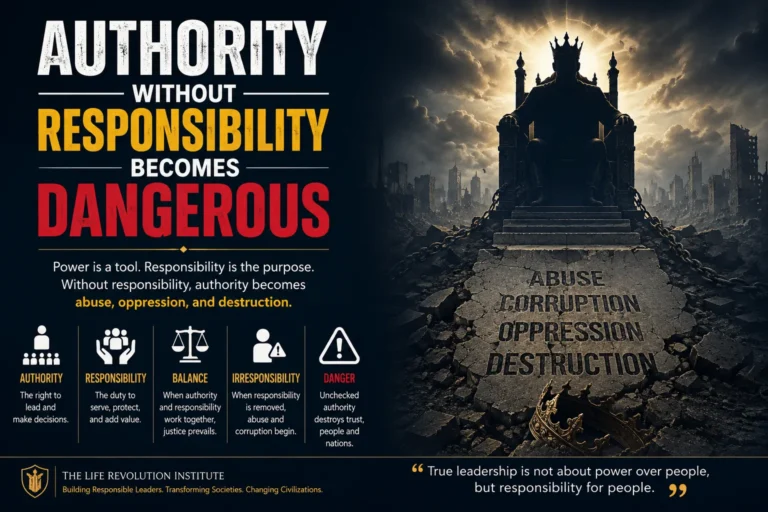
Leadership is often misunderstood as authority.
True leadership is stewardship.
Leaders shape environments where people flourish.
Responsible leaders build systems that outlast themselves.
They invest in future generations.
They improve institutional resilience.
They strengthen ethical cultures.
They cultivate successors.
Leadership therefore becomes an act of civilization building.
The measure of leadership is not popularity.
It is sustainable contribution.
Institutions Strengthen Nations
Nations are not strengthened merely by natural resources.
History disproves this assumption repeatedly.
Some resource-rich nations remain poor.
Some resource-poor nations become global leaders.
The difference often lies in institutional quality.
Strong nations possess:
- reliable legal systems
- trustworthy public institutions
- accountable governance
- quality education
- productive businesses
- effective healthcare
- secure communities
- responsible leadership
Each institution reinforces the others.
Institutional excellence generates national resilience.
Weak institutions create national vulnerability.
National Prosperity Is More Than Economic Growth
Gross Domestic Product measures production.
It does not fully measure civilization.
A prosperous nation must also possess:
social trust
ethical leadership
strong families
educated citizens
effective institutions
responsible governance
innovation
justice
public confidence
intergenerational sustainability
Economic growth without moral development often produces inequality, instability, and corruption.
True prosperity combines wealth creation with human flourishing.
Responsibility Produces National Competitiveness
The global economy increasingly rewards nations capable of producing reliable people.
Investors seek trust.
Employers seek disciplined workers.
Entrepreneurs seek competent partners.
Researchers seek credible institutions.
Innovation requires responsibility.
Economic competitiveness therefore begins long before the marketplace.
It begins in homes, classrooms, communities, and institutions where responsibility becomes culture.
The Life Revolution Institute seeks to make responsibility a measurable national advantage.
Nations Contribute to Humanity
Healthy nations do not exist only for themselves.
Every civilization contributes something valuable to humanity.
Some contribute scientific discoveries.
Others contribute legal systems.
Some contribute literature.
Others contribute medicine, engineering, philosophy, technology, or cultural excellence.
Nations become meaningful participants in global civilization when they consistently create value beyond their borders.
Contribution represents civilization at its highest level.
The question therefore shifts from:
“What can the world give us?”
to
“What can our nation contribute to humanity?”
This mindset transforms national ambition.
Humanity Is an Interconnected Civilization
Modern technology has revealed how interconnected humanity truly is.
Economic shocks cross continents.
Ideas spread instantly.
Diseases ignore borders.
Innovation becomes global.
Climate challenges require cooperation.
Artificial intelligence transforms every economy.
Therefore, responsible nations must think globally while acting responsibly locally.
The Life Revolution Institute encourages citizens and leaders to view themselves as contributors to both national development and human progress.
The Responsibility Framework
At the heart of The Life Revolution Institute is a practical framework for developing responsible human systems.
The Seven Domains of Responsibility include:
Cognitive Responsibility
Thinking accurately.
Learning continuously.
Making informed decisions.
Rejecting misinformation.
Developing wisdom.
Emotional Responsibility
Managing emotions constructively.
Practicing resilience.
Responding thoughtfully rather than impulsively.
Developing empathy.
Behavioral Responsibility
Executing consistently.
Keeping commitments.
Maintaining discipline.
Practicing ethical conduct.
Strategic Responsibility
Planning intentionally.
Aligning actions with long-term goals.
Building sustainable systems.
Anticipating future challenges.
Financial Responsibility
Creating value.
Managing resources wisely.
Investing for future generations.
Building economic resilience.
Relational Responsibility
Building trust.
Strengthening collaboration.
Resolving conflict wisely.
Creating healthy communities.
Generational Responsibility
Preserving knowledge.
Mentoring successors.
Building lasting institutions.
Creating legacy rather than temporary success.
Measuring Human Development
What cannot be measured cannot easily be improved.
Traditional education measures academic performance.
Businesses measure financial performance.
Governments measure economic performance.
The Life Revolution Institute believes human development should also be measurable.
Responsibility can be assessed.
Leadership can be evaluated.
Institutional trust can be measured.
Behavioral consistency can be observed.
Strategic thinking can be strengthened.
This evidence-based approach enables continuous improvement.
Education Beyond Information
Information alone does not transform lives.
Transformation requires:
understanding
practice
reflection
feedback
accountability
measurement
application
Education should not merely increase knowledge.
It should improve capability.
The Life Revolution Institute therefore promotes learning that changes behavior, improves decision-making, and strengthens responsibility.
A New Development Paradigm
Many societies attempt to solve national problems through isolated reforms.
Educational reform.
Economic reform.
Political reform.
Judicial reform.
Yet these efforts often fail because they overlook the human operating system beneath every institution.
The Life Revolution Institute proposes a comprehensive paradigm:
Develop responsible families.
Develop responsible individuals.
Develop responsible institutions.
Develop responsible nations.
Strengthen humanity.
Each level reinforces the next.
The Long-Term Vision
Civilizations are not built within election cycles.
They are built across generations.
Every generation inherits systems it did not create.
Every generation leaves systems it did create.
The question is whether future generations will inherit stronger institutions or weaker ones.
Greater responsibility or greater disorder.
Greater wisdom or greater confusion.
The Life Revolution Institute exists to help ensure that every generation leaves civilization stronger than it found it.
Conclusion
Civilizations are neither accidents nor mysteries.
They are the cumulative result of millions of responsible decisions made every day by families, individuals, institutions, and nations.
When families intentionally cultivate character, societies gain responsible citizens.
When responsible individuals establish trustworthy institutions, nations become stable and prosperous.
When strong nations contribute knowledge, innovation, justice, and compassion, humanity advances.
This is the vision of The Life Revolution Institute.
We are committed to researching, codifying, teaching, and deploying the structural principles that govern human flourishing and civilizational progress.
Our mission is not merely to inspire people but to build measurable systems of responsibility that strengthen families, empower individuals, transform institutions, develop nations, and advance humanity.
Civilizations rise when responsibility becomes culture.
Progress becomes sustainable when leadership is rooted in integrity.
Legacy is secured when each generation prepares the next to carry the work forward.
The future of civilization will not be determined only by technological breakthroughs or economic growth. It will be determined by whether humanity can produce responsible people who build trustworthy institutions and nations that contribute to the common good.
That is the enduring commitment of The Life Revolution Institute—to help shape a world where responsibility is the foundation of progress, institutions are engines of opportunity, nations are stewards of justice and prosperity, and humanity advances together toward a more flourishing future.
The Life Revolution Institute
Codifying the Principles That Govern Life and Civilization