Human Outcomes as the Product of Behavioral Systems
A Foundational Doctrine of The Life Revolution Institute
Human outcomes are not accidents.
They are not isolated events detached from systems, environments, or reinforcement structures. Every society, institution, nation, community, organization, family, and individual produces outcomes according to the alignment between behavior, environment, and reinforcing systems.
This is the foundation of the Structural Alignment Doctrine.
At the core of human civilization lies a simple but powerful reality:
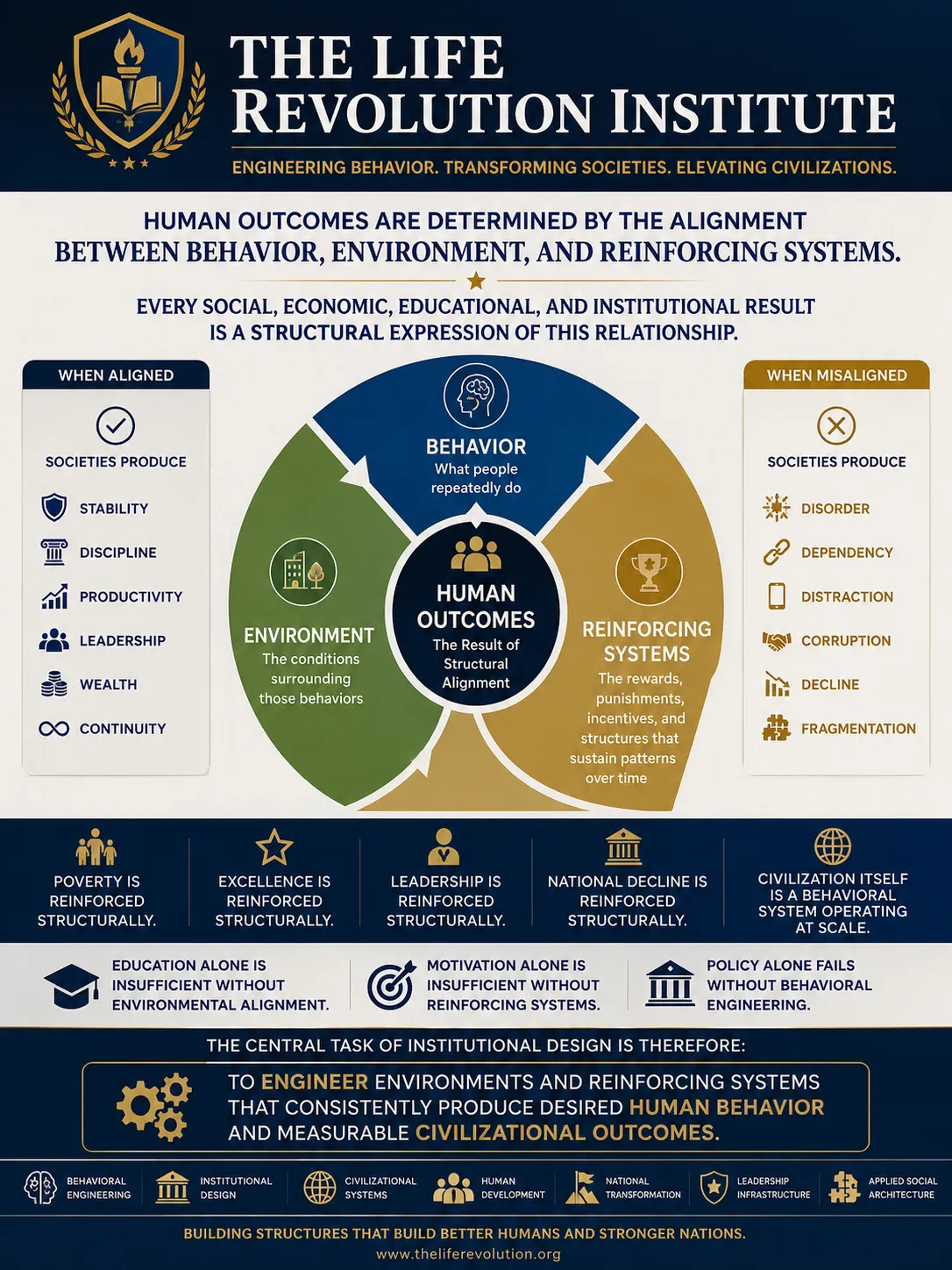
Human outcomes are determined by the alignment between behavior, environment, and reinforcing systems. Every social, economic, educational, and institutional result is a structural expression of this relationship.
This doctrine rejects the illusion that transformation happens merely through inspiration, slogans, speeches, policies, or information transfer. It argues instead that sustainable human development is engineered structurally.
People behave according to what their environment normalizes, what their systems reinforce, and what their institutions reward over time.
Therefore, every recurring societal outcome is evidence of an underlying structure.
A disciplined society is structurally engineered.
A corrupt society is structurally engineered.
A productive nation is structurally engineered.
A distracted civilization is structurally engineered.
Human behavior does not emerge in a vacuum. It emerges inside systems.
THE THREE FOUNDATIONAL FORCES
The Structural Alignment Doctrine identifies three primary determinants of human outcomes:
1. Behavior
Behavior is the visible expression of internal and external conditioning. What people repeatedly do determines what they repeatedly become.
Civilizations are not built by intentions. They are built by repeated behaviors operating consistently over time.
Discipline creates stability.
Focus creates productivity.
Responsibility creates trust.
Consistency creates mastery.
Leadership creates direction.
Likewise:
Negligence creates decline.
Distraction creates stagnation.
Dependency creates weakness.
Indiscipline creates instability.
Human beings eventually become the sum of their repeated patterns.
Therefore, behavior is the operational unit of civilization.
Every national outcome can ultimately be traced back to collective behavioral patterns operating at scale.
2. Environment
Behavior does not exist independently from environment.
The environment determines what is encouraged, tolerated, discouraged, celebrated, punished, rewarded, or normalized.
A student raised in a culture of discipline will behave differently from one raised in an environment of chaos.
A nation that glorifies production will produce creators.
A nation that glorifies consumption will produce dependence.
Environment shapes possibility.
The physical environment matters.
The educational environment matters.
The economic environment matters.
The digital environment matters.
The social environment matters.
The modern world underestimates environmental engineering while overestimating motivational language.
People rarely outperform the systems surrounding them for long periods.
An environment that rewards distraction will produce distracted populations.
An environment that rewards discipline will produce disciplined populations.
Therefore, environments are not passive realities. They are behavioral infrastructures.
3. Reinforcing Systems
The third force is reinforcement.
Whatever systems reward will expand.
Whatever systems tolerate will persist.
Whatever systems punish will diminish.
Human beings adapt to incentives faster than ideology.
If corruption is rewarded, corruption grows.
If excellence is rewarded, excellence grows.
If dependency is rewarded, dependency expands.
If innovation is rewarded, innovation accelerates.
Reinforcing systems include:
- Economic incentives
- Institutional structures
- Educational models
- Laws and policies
- Digital algorithms
- Social recognition
- Media systems
- Cultural expectations
- Organizational hierarchies
- Family structures
Civilizations are not merely belief systems. They are reinforcement systems.
This means transformation cannot happen through information alone.
Knowledge without reinforcement collapses.
Motivation without structure fades.
Education without environmental alignment fails.
The real question is never merely:
“What are people taught?”
The deeper question is:
“What behaviors are continuously reinforced?”
ALL OUTCOMES ARE STRUCTURAL
The Structural Alignment Doctrine argues that every recurring outcome is evidence of a structure operating beneath the surface.
Poverty is reinforced structurally.
Wealth is reinforced structurally.
Violence is reinforced structurally.
Peace is reinforced structurally.
Excellence is reinforced structurally.
Decline is reinforced structurally.
This does not remove personal responsibility. Instead, it expands responsibility from the individual level to the institutional and civilizational level.
Societies must examine not only individuals, but also the systems producing those individuals.
If a nation repeatedly produces corruption, the issue is not isolated morality alone. It is structural reinforcement.
If schools repeatedly produce disengaged graduates, the issue is not intelligence alone. It is structural design.
If organizations repeatedly collapse under weak leadership, the issue is not accidental failure. It is institutional misalignment.
Therefore:
Every repeated outcome is a structural signal.
THE FAILURE OF MODERN EDUCATION
Modern educational systems often focus heavily on information transfer while neglecting behavioral engineering.
Students are taught subjects but not disciplined thinking.
They receive information but lack environmental reinforcement.
They memorize concepts but fail to internalize productive behavioral systems.
As a result, societies produce educated instability.
Knowledge without discipline becomes ineffective.
Skill without responsibility becomes dangerous.
Intelligence without structure becomes inconsistent.
The Structural Alignment Doctrine therefore argues that true education must integrate:
- Behavioral formation
- Environmental alignment
- Reinforcement systems
- Identity development
- Institutional continuity
Education is not merely academic instruction.
Education is civilization programming.
THE DIGITAL ENVIRONMENT CRISIS
The modern digital environment has become one of the most powerful behavioral engineering systems in human history.
Algorithms reinforce attention patterns.
Notifications engineer interruption cycles.
Entertainment systems reward distraction.
Social media platforms monetize behavioral addiction.
This creates civilizations increasingly conditioned toward:
- Short attention spans
- Emotional impulsiveness
- Identity instability
- Dopamine dependency
- Reduced focus capacity
- Declining deep thinking
The issue is not technology itself.
The issue is behavioral reinforcement architecture.
Technology is never neutral.
It engineers outcomes.
Any civilization that ignores digital behavioral engineering risks structural decline.
Therefore, nations and institutions must intentionally build environments that reinforce:
- Focus
- Discipline
- Critical thinking
- Responsibility
- Long-term orientation
- Productive identity systems
LEADERSHIP AS ENVIRONMENTAL ENGINEERING
Leadership is not merely inspiration.
Leadership is the ability to design environments that consistently produce desired behavior.
A true leader creates systems.
A weak leader depends only on speeches.
Sustainable transformation occurs when institutions no longer rely solely on individual motivation but instead embed productive behavior into structures.
This is why great civilizations build:
- Rituals
- Standards
- Accountability systems
- Educational frameworks
- Cultural norms
- Incentive systems
- Institutional traditions
Strong systems reduce dependence on emotional consistency.
The goal of leadership is therefore not temporary excitement.
The goal is structural continuity.
THE NATIONAL IMPLICATION
Nations rise or decline according to their behavioral infrastructure.
A nation that reinforces responsibility becomes stable.
A nation that reinforces productivity becomes prosperous.
A nation that reinforces discipline becomes competitive.
A nation that reinforces dependency becomes fragile.
National transformation is therefore not primarily political rhetoric.
It is behavioral engineering at civilizational scale.
Policies alone cannot save nations if reinforcing systems reward opposite behaviors.
Economic reform without behavioral reform collapses.
Educational reform without environmental reform collapses.
Institutional reform without cultural reinforcement collapses.
Lasting national development requires structural alignment.
THE INSTITUTIONAL MISSION
The mission of institutions should not merely be administration.
The mission should be human outcome engineering.
Every institution produces behavior.
Schools produce behavioral patterns.
Governments produce behavioral expectations.
Corporations produce behavioral cultures.
Media systems produce behavioral norms.
Families produce behavioral identities.
Therefore, institutional design is one of the highest forms of societal power.
The future belongs not merely to those with resources, but to those who understand behavioral systems.
THE LIFE REVOLUTION FRAMEWORK
The Life Revolution Institute operates from the understanding that civilization itself is a behavioral system operating at scale.
Transformation requires more than awareness.
It requires:
- Behavioral engineering
- Environmental redesign
- Reinforcement restructuring
- Institutional alignment
- Leadership infrastructure
- Long-term cultural systems
The objective is not temporary inspiration.
The objective is the construction of systems that produce disciplined, responsible, focused, productive, ethical, and civilization-building human beings consistently across generations.
This is why behavior must be engineered continuously.
Because every society is already engineering behavior — either intentionally or unintentionally.
The only question is whether the outcomes are constructive or destructive.
CONCLUSION
Human outcomes are structural realities.
People become what their environments normalize.
Societies become what their systems reinforce.
Civilizations become what their institutions repeatedly produce.
Therefore, sustainable transformation requires alignment between:
- Behavior
- Environment
- Reinforcing systems
Everything else is a structural expression of this relationship.
The future of nations, institutions, and civilizations will ultimately depend on who best understands and engineers human behavior at scale.
Because civilization itself is not sustained accidentally.
It is reinforced continuously.