
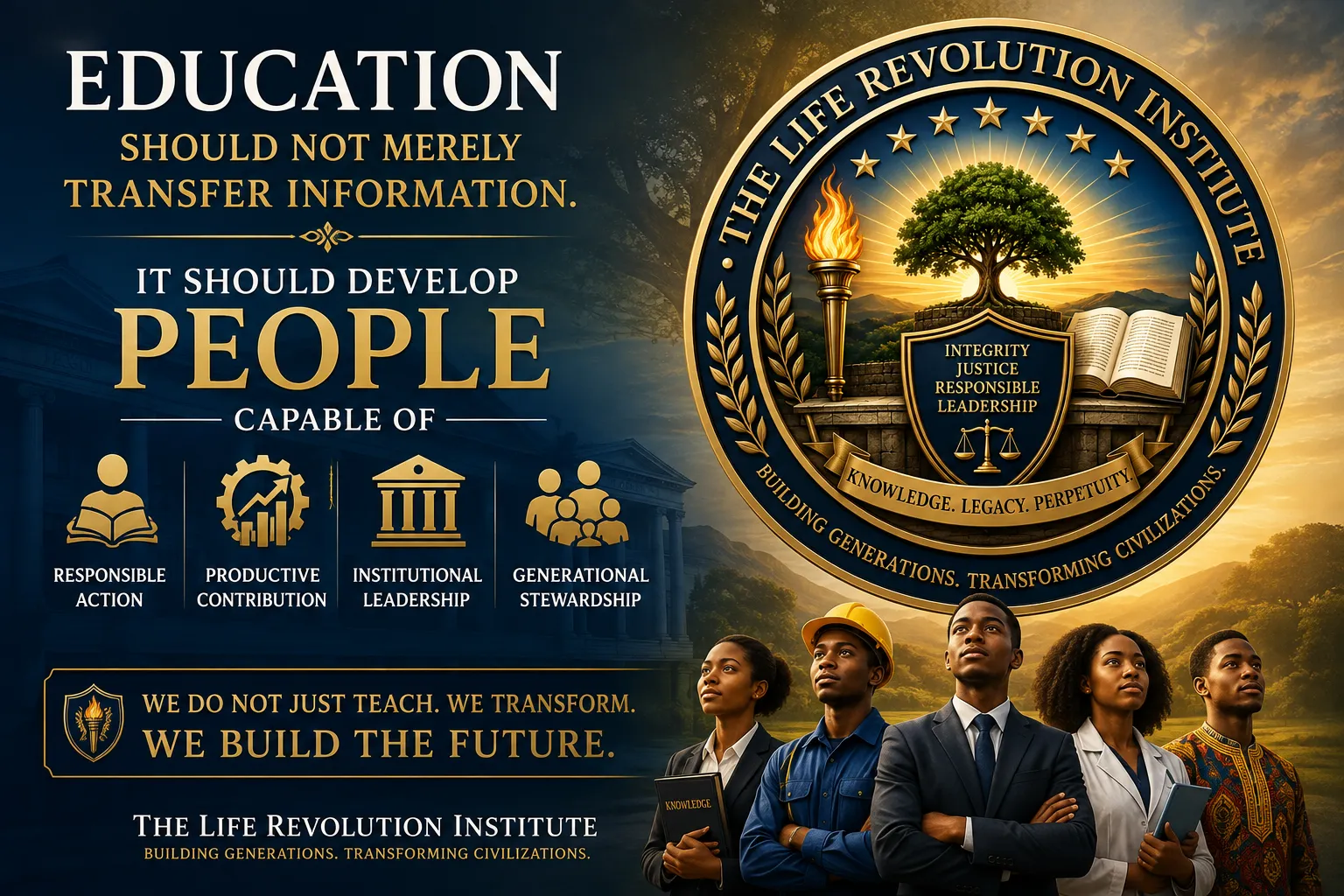
Developing People Capable of Responsible Action, Productive Contribution, Institutional Leadership, and Generational Stewardship
PREAMBLE
Education is one of the most powerful forces available to humanity.
It determines what people know, how they think, what they value, what they are capable of doing, how they relate to institutions, how they use power, how they create wealth, how they raise families, and what they leave behind for those who come after them.
For this reason, education cannot be reduced to the transfer of information.
A society may possess schools, universities, textbooks, examinations, certificates, degrees, laboratories, digital platforms, and highly educated citizens while still suffering from weak institutions, poor leadership, low productivity, irresponsible behavior, fragile families, economic dependency, and generational decline.
The existence of information does not guarantee the existence of capacity.
The existence of knowledge does not guarantee wisdom.
The possession of qualifications does not guarantee character.
The production of graduates does not automatically produce leaders.
The accumulation of academic credentials does not necessarily produce productive citizens.
The Life Revolution Institute therefore establishes an Education Doctrine founded upon a fundamental proposition:
Education should not merely transfer information. It should develop people capable of responsible action, productive contribution, institutional leadership, and generational stewardship.
This doctrine defines education as the deliberate development of human capacity for individual, institutional, societal, and generational advancement.
The Institute believes that the ultimate measure of education is not simply what a person can remember, but what that person can understand, practice, build, lead, protect, improve, and transmit.
Education must therefore move from information to understanding, from understanding to capability, from capability to responsibility, from responsibility to contribution, from contribution to leadership, and from leadership to stewardship.
The purpose of education is not merely to prepare people to pass examinations.
Its deeper purpose is to prepare people to participate meaningfully in life.
I. THE FIRST PRINCIPLE: EDUCATION MUST PRODUCE CAPACITY
Every civilization depends upon human capacity.
Institutions cannot function beyond the capacity of the people operating them.
Economies cannot sustainably produce beyond the productive capacity of their citizens.
Governments cannot govern effectively beyond the competence and integrity of their leadership.
Families cannot transmit stability beyond the capacity of parents and guardians.
Organizations cannot become stronger than the systems, culture, and people that sustain them.
Therefore, education must be understood as a capacity-building institution.
Capacity is the ability to understand reality, make sound decisions, perform useful work, solve problems, cooperate with others, exercise judgment, accept responsibility, and produce results.
A person may possess extensive information and still lack capacity.
A person may know the principles of financial management but be incapable of managing resources.
A person may understand leadership theory but be incapable of leading people.
A person may study organizational development but be unable to build an effective institution.
A person may understand civic responsibility but fail to practice it.
A person may possess a university degree but lack the discipline required to translate knowledge into contribution.
The Education Doctrine therefore rejects the assumption that information automatically becomes capability.
Education must intentionally construct the bridge.
That bridge consists of several stages:
Information → Understanding → Skill → Practice → Judgment → Responsibility → Contribution → Leadership → Stewardship.
The educational system must be designed around this progression.
II. EDUCATION AS HUMAN DEVELOPMENT
The Institute defines education as the structured development of the whole person.
This does not mean that every educational institution must teach every subject.
It means that education must recognize that human performance is multidimensional.
People require knowledge.
They also require judgment.
They require technical competence.
They also require discipline.
They require ambition.
They also require responsibility.
They require individual achievement.
They also require the ability to contribute to systems larger than themselves.
A complete education therefore develops at least five dimensions of human capacity:
- Intellectual capacity
- Behavioral capacity
- Productive capacity
- Institutional capacity
- Generational capacity
1. Intellectual Capacity
Intellectual capacity is the ability to learn, reason, analyze, question, synthesize, communicate, and make informed judgments.
Education must develop people who can distinguish evidence from assumption, facts from opinions, principles from preferences, and short-term appearances from long-term consequences.
The educated person should not merely possess answers.
The educated person should know how to think.
2. Behavioral Capacity
Knowledge becomes meaningful when it changes behavior.
Behavioral capacity is the ability to convert values and knowledge into consistent action.
This includes discipline, reliability, emotional regulation, perseverance, accountability, time management, ethical conduct, and the ability to operate according to principles even when circumstances are difficult.
An education that produces intelligent but unreliable people is incomplete.
3. Productive Capacity
Productive capacity is the ability to create useful value.
Education should prepare people to solve problems, perform work, create enterprises, develop technologies, manage resources, provide services, build organizations, and improve existing systems.
Productivity must become an educational concern.
A society cannot become prosperous merely by producing people who can describe problems.
It requires people capable of solving them.
4. Institutional Capacity
Civilization is sustained through institutions.
Schools, families, businesses, governments, professional bodies, research organizations, civil society institutions, communities, and cultural organizations all require competent people.
Education must therefore teach individuals how institutions work and how institutions are built, governed, improved, protected, and renewed.
5. Generational Capacity
The highest expression of education is stewardship.
A person should not graduate from education thinking only about what they can obtain.
They should also understand what they are responsible for preserving, improving, and transmitting.
Generational capacity is the ability to think beyond one’s immediate interests and contribute to conditions under which future generations can flourish.
This is the educational foundation of legacy and perpetuity.
III. THE FOUR OUTCOMES OF EDUCATION
The Life Revolution Institute identifies four principal outcomes that education must deliberately develop:
Responsible Action
Productive Contribution
Institutional Leadership
Generational Stewardship
These four outcomes form an educational progression.
A responsible person can govern their actions.
A productive person can create value.
A leader can organize people and systems toward worthwhile objectives.
A steward can preserve and improve what has been entrusted to them for future generations.
Together, they describe a mature conception of education.
IV. RESPONSIBLE ACTION
The First Educational Outcome
Responsibility is the foundation upon which every higher form of contribution rests.
Responsibility means recognizing that actions have consequences and that individuals have obligations toward themselves, other people, institutions, society, and the future.
Education must therefore teach people not merely what they are entitled to receive, but what they are capable of contributing.
The responsible person asks:
What is my responsibility here?
What consequences will my decisions create?
What must I do even when nobody is watching?
What resources have been entrusted to me?
What obligations accompany my freedom?
Responsibility transforms education from passive consumption into active citizenship.
Responsibility and Freedom
Freedom without responsibility produces instability.
Education must therefore teach that freedom is inseparable from consequence.
The more authority a person receives, the greater the responsibility associated with that authority.
The more resources a person controls, the greater the responsibility associated with those resources.
The more influence a person possesses, the greater the responsibility associated with that influence.
This principle is especially important in leadership education.
The Institute rejects leadership models that define leadership primarily as status, visibility, privilege, or personal power.
Leadership must be understood as entrusted responsibility.
Responsibility in Daily Life
Responsible action includes:
- keeping commitments;
- respecting legitimate rules;
- managing time;
- caring for resources;
- completing assigned work;
- accepting consequences;
- correcting mistakes;
- honoring agreements;
- treating people with dignity;
- protecting institutional trust;
- and continuously improving one’s performance.
These behaviors may appear ordinary. Civilization depends upon them.
Institutions become strong when ordinary responsibilities are performed consistently.
V. PRODUCTIVE CONTRIBUTION
The Second Educational Outcome
Education must prepare people to contribute value.
The Institute defines productivity broadly.
Productivity is not merely working harder.
It is the ability to convert time, knowledge, resources, creativity, technology, relationships, and effort into useful outcomes.
A productive person does not merely consume systems.
They improve systems.
They do not merely identify needs. They develop solutions.
They do not merely seek employment. They develop employable and entrepreneurial capacity.
They do not merely criticize institutions. They learn how institutions can be strengthened.
From Consumption to Contribution
Modern societies can easily create cultures of consumption.
People consume information.
They consume entertainment.
They consume products.
They consume public resources.
They consume institutional services.
Education must counterbalance this tendency by developing a culture of contribution.
Students must repeatedly encounter the question:
What useful value can you create with what you have learned?
This question transforms education.
A lesson in economics should eventually connect to economic decision-making.
A lesson in science should develop problem-solving capability.
A lesson in communication should improve the ability to persuade, explain, negotiate, and collaborate.
A lesson in leadership should result in demonstrated leadership behavior.
A lesson in entrepreneurship should involve the creation and testing of solutions.
Education should therefore become increasingly applied as learners advance.
VI. EDUCATION AND THE CULTURE OF WORK
Work is one of the principal mechanisms through which human capability becomes social value.
Education must therefore restore dignity to productive work.
Every society requires people capable of building, repairing, organizing, researching, teaching, farming, designing, manufacturing, managing, caring, innovating, governing, and serving.
The Institute rejects the false distinction between intellectual development and productive work.
Thinking is work.
Building is work.
Research is work.
Management is work.
Care is work.
Innovation is work.
Leadership is work.
Education should teach people to respect useful contribution regardless of occupational category.
The critical question is not merely:
What position do you hold?
It is:
What value do you reliably create?
VII. INSTITUTIONAL LEADERSHIP
The Third Educational Outcome
Individuals do not live in isolation.
They live inside systems.
Families are systems.
Schools are systems.
Businesses are systems.
Governments are systems.
Communities are systems.
Nations are systems.
Civilization itself is an interconnected institutional system.
Consequently, education must prepare people not only to function within institutions but also to lead and improve them.
Institutional leadership requires a different level of thinking.
The individual asks:
What should I do?
The institutional leader asks:
How should we organize people, resources, incentives, processes, knowledge, and accountability so that the desired outcome becomes sustainable?
This shift is fundamental.
Leadership is not merely personal excellence.
Leadership is the capacity to create conditions in which collective excellence becomes possible.
VIII. LEADERSHIP AS STEWARDSHIP OF SYSTEMS
The Institute defines leadership as responsible stewardship of people, resources, authority, institutions, and outcomes.
This definition contains several principles.
Leadership Requires Competence
Good intentions are insufficient.
Leaders must understand the systems they are responsible for.
Leadership Requires Character
Competence without integrity can become destructive.
Leadership Requires Accountability
Authority must be accompanied by mechanisms through which decisions can be examined and consequences addressed.
Leadership Requires Vision
Institutions need direction.
Leadership Requires Execution
Vision without implementation produces rhetoric rather than results.
Leadership Requires Continuity
A strong institution should not collapse simply because one leader leaves.
This final principle is essential to the Institute’s philosophy.
The purpose of institutional leadership is not to make oneself indispensable.
The purpose is to build systems capable of continuing without oneself.
IX. FROM HEROIC LEADERSHIP TO INSTITUTIONAL LEADERSHIP
Many societies become overly dependent upon exceptional individuals.
When one person becomes the institution, the institution becomes fragile.
The Life Revolution Institute therefore teaches a different model.
The objective is to transform:
Person → Team → System → Institution → Continuity.
A mature leader builds people.
People build teams.
Teams build systems.
Systems strengthen institutions.
Institutions create continuity.
Continuity protects civilization from unnecessary dependence upon individual personalities.
Education must therefore teach succession, documentation, governance, delegation, institutional memory, standards, measurement, and leadership development.
This is how education becomes civilization-building.
X. GENERATIONAL STEWARDSHIP
The Fourth Educational Outcome
Generational stewardship represents the highest level of the Education Doctrine.
Stewardship means recognizing that life, knowledge, institutions, culture, resources, and opportunities are inherited as well as transmitted.
Every generation receives something.
Every generation changes something.
Every generation leaves something.
The question is whether it leaves the next generation with greater capacity or diminished capacity.
The Institute therefore teaches the principle:
We are not merely beneficiaries of civilization; we are temporary custodians of it.
This principle changes how people think about education.
Education becomes preparation for inheritance and stewardship.
A student is not merely preparing for a career.
They are preparing to become a future parent, professional, entrepreneur, teacher, leader, institution-builder, citizen, mentor, and steward.
XI. THE GENERATIONAL TEST
The Institute proposes a simple test for major decisions:
Will this decision increase or decrease the capacity of those who come after us?
This question can be applied to:
- education;
- public policy;
- environmental decisions;
- institutional governance;
- family development;
- financial management;
- infrastructure;
- technology;
- culture;
- leadership succession;
- research;
- and national development.
Generational thinking does not mean ignoring the present.
It means refusing to sacrifice the future unnecessarily for immediate convenience.
The mature educational system therefore develops long-horizon thinking.
Students should learn to evaluate consequences across multiple time horizons:
Today → This Year → This Generation → Future Generations.
XII. EDUCATION AS CIVILIZATIONAL INFRASTRUCTURE
The Institute regards education as infrastructure.
Roads move people.
Electricity powers systems.
Digital networks move information.
Financial systems move capital.
Educational systems develop human capacity.
Without human capacity, physical infrastructure cannot be adequately designed, operated, maintained, governed, or improved.
Education is therefore not merely a social service.
It is foundational civilization infrastructure.
The quality of a nation’s education system affects the quality of its:
- leadership;
- workforce;
- institutions;
- scientific capacity;
- businesses;
- families;
- civic culture;
- public administration;
- research;
- technological development;
- and long-term national resilience.
Investment in education is therefore investment in civilization.
XIII. EDUCATION MUST DEVELOP CHARACTER AND COMPETENCE TOGETHER
One of the central errors in education is treating character and competence as separate concerns.
They are complementary.
Competence answers:
Can you do it?
Character asks:
Should you do it?
Competence without character can produce highly capable misconduct.
Character without competence can produce good intentions without sufficient effectiveness.
A mature educational system develops both.
The Institute therefore adopts the principle:
Character determines the direction of capability; competence determines the effectiveness of capability.
Education must produce people who are both capable and trustworthy.
XIV. KNOWLEDGE, WISDOM, AND JUDGMENT
Information is the raw material.
Knowledge is organized understanding.
Wisdom is the ability to apply understanding appropriately.
Judgment is the capacity to choose among competing actions under real-world conditions.
Education should therefore move progressively upward:
Information
↓
Knowledge
↓
Understanding
↓
Application
↓
Experience
↓
Judgment
↓
Wisdom
The educational process becomes incomplete when it stops at information.
A student may know the theory but not know when to apply it.
A professional may know the procedure but not understand the consequences.
A leader may understand a policy but fail to recognize its institutional effects.
Education must therefore expose learners to complexity, uncertainty, trade-offs, case studies, simulations, projects, practical problems, and real responsibilities appropriate to their level of development.
XV. THE DOCTRINE OF PRACTICE
The Institute holds that capability is developed through repeated application.
For this reason:
What is practiced becomes easier to perform. What is repeatedly practiced becomes a pattern. What becomes a pattern can become a habit. What becomes habitual can become character.
Education must therefore contain practice.
Students should not merely read about responsibility.
They should practice responsibility.
They should not merely study leadership.
They should lead appropriate projects.
They should not merely study productivity.
They should complete meaningful work.
They should not merely discuss problem-solving.
They should solve problems.
They should not merely learn about stewardship.
They should participate in activities that require them to care for shared resources and responsibilities.
The classroom should therefore become a training environment rather than merely an information environment.
XVI. EDUCATION AND ACCOUNTABILITY
Accountability is an essential educational mechanism.
Without accountability, knowledge can remain theoretical.
The Institute therefore promotes educational systems in which learners receive feedback on both knowledge and behavior.
Assessment should measure multiple dimensions.
These may include:
- conceptual understanding;
- practical competence;
- communication;
- problem-solving;
- reliability;
- teamwork;
- project execution;
- ethical reasoning;
- leadership;
- and demonstrated contribution.
The purpose of assessment should not be humiliation or punishment.
Its purpose should be diagnosis, improvement, and evidence of capability.
The Institute therefore encourages a transition from:
Assessment of memory
to
Assessment of mastery.
XVII. EDUCATION AND THE SEVEN CONSTITUTIONAL PILLARS
The Education Doctrine exists within the broader constitutional architecture of The Life Revolution Institute.
Education must therefore contribute to the development of the Institute’s Seven Constitutional Pillars.
Responsibility
Education teaches people to govern themselves and accept the consequences of their decisions.
Focus
Education teaches people to distinguish what matters from what distracts them.
Discipline
Education converts intention into consistent action.
Wealth
Education develops the capacity to create, manage, multiply, and responsibly deploy resources.
Power
Education teaches people to understand influence, authority, institutions, governance, and responsibility.
Legacy
Education prepares people to transmit knowledge, values, institutions, and achievements to future generations.
Perpetuity
Education develops systems capable of continuing, adapting, renewing, and serving humanity beyond individual lifetimes.
These pillars prevent education from becoming an isolated intellectual activity.
They position education within a larger philosophy of human development.
XVIII. THE EDUCATED PERSON
According to this doctrine, an educated person is not defined solely by certificates.
An educated person is someone who has developed meaningful capacity.
The educated person should increasingly demonstrate the ability to:
- Think clearly.
- Learn continuously.
- Act responsibly.
- Manage themselves.
- Solve problems.
- Create value.
- Communicate effectively.
- Work with others.
- Exercise sound judgment.
- Lead responsibly.
- Strengthen institutions.
- Manage resources wisely.
- Teach and mentor others.
- Preserve valuable knowledge.
- Improve inherited systems.
- Prepare successors.
- Think across generations.
- Contribute to human advancement.
This is a higher standard than academic certification alone.
A certificate may indicate that a person completed a course.
Capability demonstrates what the person can actually do.
XIX. THE EDUCATOR AS CAPACITY BUILDER
The Education Doctrine also changes the role of the educator.
The educator is not merely an information provider.
The educator is a capacity builder.
The educator must therefore ask:
What should this learner be capable of doing after this experience?
This question changes curriculum design.
Instead of beginning with:
What information should I teach?
The educator begins with:
What capacity must be developed?
Then:
What knowledge supports that capacity?
Then:
What practice develops it?
Then:
What evidence demonstrates mastery?
This produces a more intentional educational architecture.
The educator becomes a designer of developmental experiences.
XX. THE INSTITUTE’S EDUCATIONAL METHOD
The Life Revolution Institute should therefore organize its educational programs around a developmental cycle:
1. Teach
Introduce the principle, concept, model, or body of knowledge.
2. Explain
Connect the concept to real-world circumstances.
3. Demonstrate
Show what competent application looks like.
4. Practice
Allow the learner to apply the concept.
5. Challenge
Introduce complexity and realistic constraints.
6. Assess
Measure understanding and performance.
7. Correct
Identify weaknesses and provide feedback.
8. Repeat
Strengthen the capability through continued application.
9. Transfer
Move the capability into real-life contexts.
10. Teach Others
Require the learner, when appropriate, to transmit what has been learned.
The final stage is particularly powerful.
Teaching others forces deeper understanding and begins the process of generational transmission.
XXI. EDUCATION FOR NATION-BUILDING
A national education system should not merely produce individual career success.
It should produce national capacity.
A nation requires:
- competent public servants;
- ethical entrepreneurs;
- skilled professionals;
- responsible citizens;
- capable teachers;
- researchers;
- engineers;
- administrators;
- institution-builders;
- community leaders;
- and future leaders capable of governing complexity.
Education must therefore be connected to national development.
The Institute’s approach to education is consequently compatible with nation-building because it emphasizes capacity before outcomes.
A nation cannot sustainably achieve outcomes it lacks the human capacity to produce and maintain.
Therefore:
Build people. Build institutions. Build systems. Build nations.
XXII. YOUTH DEVELOPMENT
Young people should not be treated merely as future beneficiaries of society.
They are developing participants in society.
Education should therefore provide age-appropriate opportunities for responsibility, contribution, leadership, creativity, enterprise, service, and stewardship.
Young people should progressively move from:
Dependence → Participation → Responsibility → Contribution → Leadership → Stewardship.
This progression should be reflected in curriculum design.
Youth education must also recognize that habits formed early can influence later performance.
The objective is not to burden young people with adult responsibilities prematurely.
It is to cultivate progressively appropriate capacity.
Young people should learn that their choices matter, their actions have consequences, their skills can create value, and their development can eventually become a resource for others.
XXIII. FAMILY AND EDUCATION
Education does not begin at the classroom door.
The family is one of the earliest and most influential educational institutions.
Children learn from what families repeatedly demonstrate.
They observe how adults handle responsibility, money, conflict, work, time, relationships, authority, failure, and opportunity.
The Institute therefore regards family development as complementary to formal education.
Educational systems should help families understand that education is not merely homework and examination preparation.
It includes:
- habits;
- values;
- communication;
- responsibility;
- decision-making;
- resource management;
- cooperation;
- service;
- and intergenerational transmission.
The family and educational institution should therefore reinforce rather than contradict essential developmental principles.
XXIV. TECHNOLOGY AND THE EDUCATION DOCTRINE
Technology has transformed access to information.
Artificial intelligence, digital platforms, online libraries, simulations, learning management systems, communication tools, and global knowledge networks can dramatically increase educational access.
But technological access does not eliminate the need for judgment.
Indeed, as information becomes easier to obtain, judgment becomes more important.
The educational challenge of the future will increasingly be not:
Can you find information?
but:
Can you determine what information is reliable, relevant, ethical, and useful?
Technology should therefore expand educational capacity without replacing human responsibility.
The Institute supports technology as an educational multiplier.
It must remain a tool.
Human judgment, character, responsibility, and stewardship remain central.
XXV. THE INSTITUTIONAL STANDARD
The Life Revolution Institute should hold itself accountable to the same Education Doctrine it teaches.
An institute that teaches institutional leadership must demonstrate institutional leadership.
An institute that teaches responsibility must practice responsibility.
An institute that teaches stewardship must preserve institutional knowledge.
An institute that teaches perpetuity must build systems capable of continuing beyond individual founders and generations.
This means the Institute must continuously develop:
- documented standards;
- curriculum systems;
- instructor development;
- assessment frameworks;
- governance structures;
- institutional records;
- certification standards;
- research capacity;
- succession systems;
- digital infrastructure;
- and mechanisms for continuous improvement.
The Institute must become an example of the educational principles it advocates.
XXVI. EDUCATION AND INSTITUTIONAL MEMORY
Civilization advances when knowledge is preserved.
Every generation should not have to rediscover what previous generations already learned.
Institutional memory therefore becomes a strategic educational asset.
The Institute should document:
- principles;
- curricula;
- research;
- case studies;
- institutional decisions;
- best practices;
- failures;
- lessons learned;
- standards;
- methodologies;
- and historical records.
This creates a knowledge inheritance.
The Institute should become not only a school but also a repository of institutional learning.
Its objective should be to create educational assets capable of serving successive generations.
XXVII. THE STANDARD OF CONTINUOUS IMPROVEMENT
No educational system should consider itself finished.
Human circumstances change.
Technology changes.
Economies change.
Institutions change.
Knowledge changes.
Social conditions change.
Therefore, education must contain mechanisms for renewal.
The Institute adopts the principle:
Preserve principles. Improve methods. Update knowledge. Strengthen institutions. Prepare successors.
Continuity does not mean stagnation.
Perpetuity requires adaptation.
A system that cannot adapt eventually becomes incapable of serving the people it was created to serve.
Education must therefore teach both stability and adaptation.
XXVIII. THE DOCTRINE OF CONTRIBUTION
The ultimate test of education is contribution.
The question is not simply:
What did you learn?
It is:
What became possible because you learned it?
Did you become more responsible?
Did your family become stronger?
Did your organization become more effective?
Did your community benefit?
Did you create employment or value?
Did you solve a problem?
Did you strengthen an institution?
Did you mentor someone?
Did you preserve knowledge?
Did you improve something you inherited?
Did you prepare another person to succeed?
These are deeper educational outcomes.
Education becomes meaningful when knowledge produces positive consequences.
XXIX. EDUCATION AND LEGACY
Legacy is not merely fame.
Legacy is what remains useful after one’s direct involvement ends.
A teacher leaves legacy through students.
A researcher leaves legacy through knowledge.
An entrepreneur leaves legacy through institutions and value creation.
A leader leaves legacy through people and systems.
A parent leaves legacy through character, knowledge, values, and opportunity transmitted to the next generation.
An institution leaves legacy through the people it develops and the systems it establishes.
The Education Doctrine therefore connects education directly to legacy.
Every educated person should eventually become capable of becoming an educator in some form.
This does not mean everyone becomes a professional teacher.
It means everyone who has acquired valuable knowledge should develop the ability to transmit appropriate knowledge responsibly.
Thus:
Learning → Application → Contribution → Transmission.
XXX. EDUCATION AND PERPETUITY
The final question is whether educational value can survive beyond individual participants.
Perpetuity requires systems.
A powerful educational idea that exists only in one person’s memory is fragile.
A principle documented, taught, practiced, assessed, institutionalized, improved, and transmitted becomes durable.
The Institute therefore seeks to transform educational ideas into institutional infrastructure.
The ultimate ambition is not merely to produce graduates.
It is to produce generations of capable people who produce other capable people.
This creates a multiplying effect:
One learner develops capacity.
One capable person develops others.
Those people strengthen institutions.
Those institutions develop more people.
Those generations transmit stronger systems.
This is how education becomes a civilization-building mechanism.
XXXI. THE EDUCATION DOCTRINE IN ONE FORMULA
The Life Revolution Institute may express its Education Doctrine through the following formula:
Knowledge + Character + Practice + Responsibility + Contribution + Leadership + Stewardship = Transformational Education
Knowledge provides understanding.
Character provides direction.
Practice develops competence.
Responsibility establishes accountability.
Contribution converts capacity into value.
Leadership organizes collective capacity.
Stewardship extends value across generations.
No single component is sufficient by itself.
Together they create transformational education.
XXXII. THE INSTITUTE’S EDUCATIONAL COMMITMENT
The Life Revolution Institute therefore commits itself to developing educational systems that:
- Teach knowledge with purpose.
- Develop judgment rather than memorization alone.
- Convert theory into practical capability.
- Cultivate responsibility.
- Develop discipline and reliability.
- Promote productive contribution.
- Build leadership capacity.
- Strengthen institutional thinking.
- Encourage ethical use of power.
- Develop responsible resource management.
- Encourage lifelong learning.
- Preserve institutional knowledge.
- Develop succession and continuity.
- Prepare learners for generational responsibility.
- Connect education to nation-building.
- Measure demonstrated capability.
- Encourage continuous improvement.
- Build systems capable of serving future generations.
These commitments constitute the operational expression of the doctrine.
XXXIII. THE FINAL STANDARD
The Institute ultimately proposes a higher question for education.
Not:
How many students did we teach?
Not:
How many certificates did we issue?
Not:
How many examinations did they pass?
Those measures may be useful.
But they are incomplete.
The deeper question is:
What kind of people did education help them become, and what became possible because they became those people?
If education produces people who can think clearly, act responsibly, work productively, lead institutions, solve problems, create value, protect what matters, develop others, and prepare the future, then education has fulfilled its deeper purpose.
If education produces information without capability, credentials without competence, ambition without responsibility, leadership without stewardship, or achievement without contribution, then education remains incomplete.
The purpose of education is therefore not merely to create knowledgeable individuals.
It is to develop capable human beings.
Capable human beings create productive families.
Productive families strengthen communities.
Capable citizens strengthen institutions.
Strong institutions strengthen nations.
Strong nations contribute to civilization.
And civilizations endure when successive generations inherit not only the achievements of the past, but also the capacity to improve them.
CONCLUSION
The Life Revolution Institute establishes this Education Doctrine upon a simple but consequential belief:
Education is the organized development of human capacity for responsible action, productive contribution, institutional leadership, and generational stewardship.
Information matters.
Knowledge matters.
Credentials matter.
Academic excellence matters.
But they are means rather than the final destination.
The final destination is human capacity.
The educated person must increasingly become capable of governing themselves, contributing value, solving problems, leading responsibly, strengthening institutions, developing others, preserving knowledge, and preparing the future.
Education must therefore move beyond the question of what people know.
It must ask what they can do with what they know.
It must ask what kind of character accompanies their capability.
It must ask whether their capability creates value.
It must ask whether their leadership strengthens or weakens institutions.
It must ask whether their achievements survive them.
And ultimately, it must ask whether the generation that follows them inherits greater capacity than the generation before them possessed.
This is the standard of transformational education.
This is the standard of institutional education.
This is the standard of civilization-building education.
The Life Revolution Institute therefore rejects education as mere information transfer and embraces education as capacity development.
We teach knowledge.
We develop capability.
We cultivate responsibility.
We build productive citizens.
We develop institutional leaders.
We prepare stewards of the future.
Because education should not merely prepare people to live within civilization.
Education should prepare people to strengthen, lead, renew, and advance civilization.
THE EDUCATION DOCTRINE — INSTITUTIONAL DECLARATION
We believe education is a responsibility to the future.
We believe knowledge must become capability.
We believe capability must become contribution.
We believe contribution must be guided by character.
We believe leadership must be exercised as stewardship.
We believe institutions must be strengthened beyond individual personalities.
We believe every generation has a responsibility to improve what it inherits.
We believe the highest form of education is the capacity to develop others.
We believe the strongest educational legacy is a generation capable of producing another capable generation.
And therefore:
The Life Revolution Institute exists not merely to teach people what to know, but to develop people capable of responsible action, productive contribution, institutional leadership, and generational stewardship.
Building Generations. Transforming Civilizations.
THE LIFE REVOLUTION INSTITUTE