
Executive Summary
For more than two centuries, governments, economists, engineers, and policy institutions have measured civilization primarily through physical infrastructure. Roads, ports, airports, railways, hospitals, power plants, telecommunications, and digital networks have become the accepted indicators of national development.
While these systems are indispensable, they are not the first infrastructure.
Every physical system originates from human systems.
Before a bridge is built, human cognition designs it.
Before a government functions, people exercise responsibility.
Before markets exist, trust enables exchange.
Before institutions survive, culture sustains cooperation.
Civilizations rise because human systems function effectively.
Civilizations decline when those systems deteriorate.
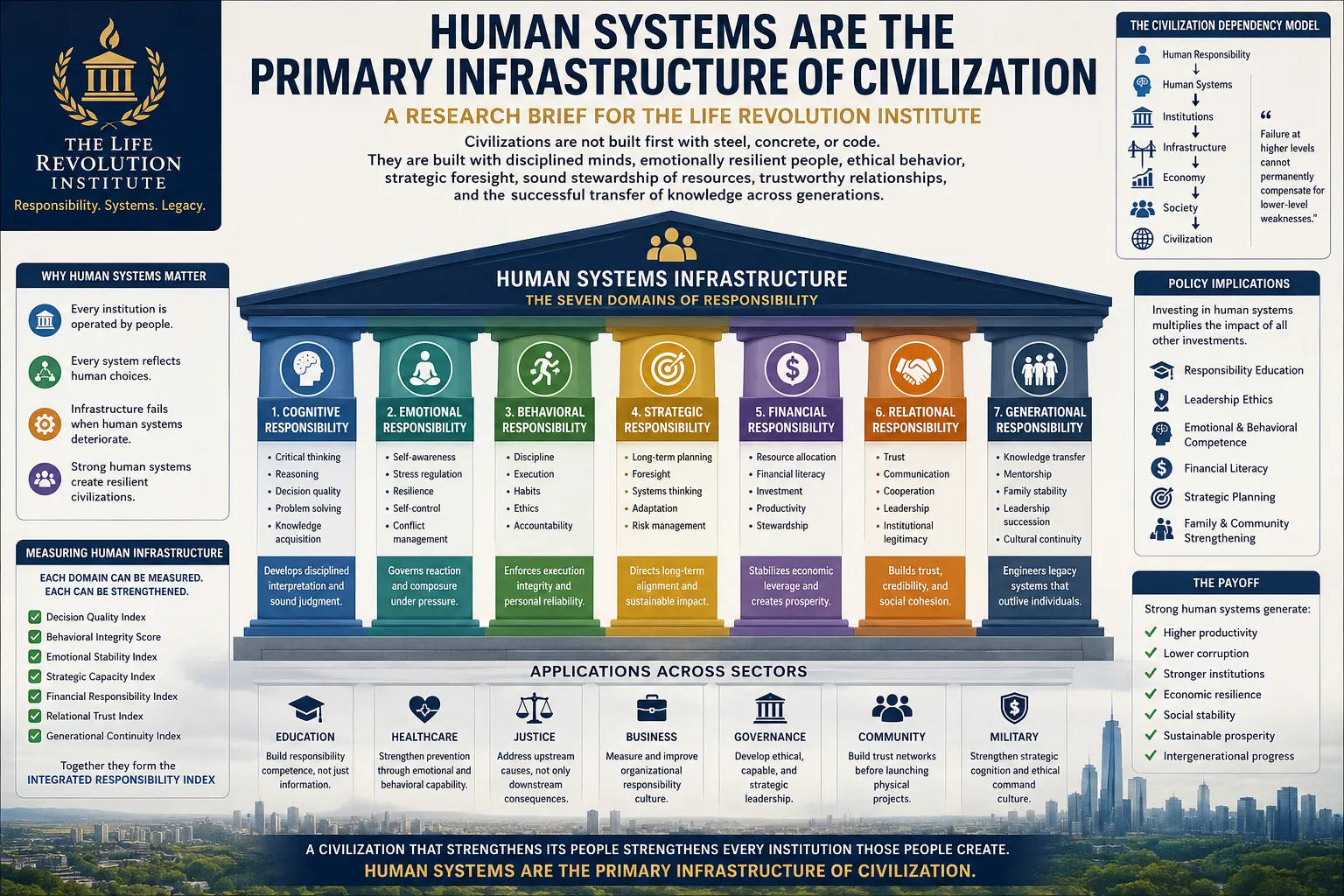
This research brief introduces a Human Systems Infrastructure Framework developed within The Life Revolution Institute that argues the foundational infrastructure of civilization is neither concrete nor technology, but the integrated capacity of individuals and institutions to think, regulate emotions, behave responsibly, plan strategically, manage resources, cooperate socially, and preserve generational continuity.
The framework aligns with the Institute’s doctrine of the Seven Domains of Responsibility:
- Cognitive Responsibility
- Emotional Responsibility
- Behavioral Responsibility
- Strategic Responsibility
- Financial Responsibility
- Relational Responsibility
- Generational Responsibility
These domains form the operating architecture upon which all other infrastructures depend.
1. Introduction
Nearly every international development index evaluates nations through economic performance, institutional strength, education levels, healthcare outcomes, infrastructure quality, and governance indicators.
Few ask a more fundamental question:
What produces these systems?
Roads do not build themselves.
Institutions do not regulate themselves.
Democracies do not sustain themselves.
Economies do not organize themselves.
People do.
Human systems precede institutional systems.
Institutional systems precede physical systems.
Physical systems generate societal outcomes.
Ignoring this hierarchy produces policies that continuously repair symptoms rather than addressing systemic causes.
The Life Revolution Institute proposes a reversal of development thinking:
Human development is not merely one sector among many—it is the infrastructure from which every sector emerges.
2. Defining Human Systems
Human systems refer to the integrated capacities through which individuals and groups process information, regulate behavior, cooperate, allocate resources, transmit knowledge, and sustain collective functioning across generations.
Human systems include:
- cognition
- emotional regulation
- habits
- ethical reasoning
- leadership
- organizational culture
- trust
- accountability
- long-term planning
- financial stewardship
- family systems
- institutional norms
Unlike physical infrastructure, human systems are invisible.
Yet they determine whether visible infrastructure succeeds or fails.
3. Infrastructure Reconsidered
Traditional infrastructure consists of:
- transportation
- water
- sanitation
- communications
- healthcare
- energy
- housing
These are essential.
However, each depends upon upstream human infrastructure.
Example:
A hospital requires:
trained physicians
ethical conduct
emotional resilience
financial accountability
leadership
communication
continuous learning
Without these, buildings become ineffective regardless of equipment.
The same principle applies across every institution.
4. Civilization as a System of Human Coordination
Civilizations represent large-scale coordination systems.
Coordination requires:
shared knowledge
trust
responsibility
predictability
discipline
planning
adaptation
These are not engineering products.
They are human capabilities.
The collapse of coordination precedes the collapse of infrastructure.
History repeatedly demonstrates this sequence.
5. Historical Evidence
Examples include:
Roman administrative decline
Mayan societal fragmentation
Late Qing governance failures
Soviet institutional breakdown
Corporate collapses driven by leadership failures
Financial crises driven by behavioral irrationality
None were caused initially by missing roads.
They began with failures inside human systems.
6. Human Systems as Infrastructure Layers
The Institute identifies seven foundational layers.
Layer 1
Cognitive Infrastructure
Functions:
critical thinking
reasoning
decision quality
problem solving
knowledge acquisition
Poor cognition produces poor institutions.
Layer 2
Emotional Infrastructure
Functions:
resilience
stress regulation
conflict management
self-control
Civilizations with widespread emotional instability experience higher violence, corruption, and institutional volatility.
Layer 3
Behavioral Infrastructure
Functions:
discipline
execution
ethics
habits
accountability
Behavior transforms intentions into outcomes.
Layer 4
Strategic Infrastructure
Functions:
long-term planning
adaptation
foresight
systems thinking
risk management
Strategy prevents reactive governance.
Layer 5
Financial Infrastructure
Functions:
resource allocation
capital preservation
investment
productivity
stewardship
Economic resilience begins with financial responsibility.
Layer 6
Relational Infrastructure
Functions:
trust
cooperation
communication
leadership
institutional legitimacy
Trust dramatically lowers transaction costs.
Layer 7
Generational Infrastructure
Functions:
knowledge transfer
mentorship
family stability
leadership succession
cultural continuity
Civilizations survive because knowledge outlives individuals.
7. The Seven Domains of Responsibility
The Life Revolution Institute organizes these infrastructures into the Seven Domains of Responsibility.
Each domain represents an operational system.
Each system contains measurable indicators.
Each indicator influences national performance.
The framework therefore moves responsibility from moral philosophy into measurable systems science.
8. Systems Dependency Model
The proposed dependency chain is:
Human Responsibility
↓
Human Systems
↓
Institutions
↓
Infrastructure
↓
Economy
↓
Society
↓
Civilization
Failure at higher levels cannot permanently compensate for lower-level weaknesses.
9. Measuring Human Infrastructure
Potential indicators include:
Decision Quality Index
Behavioral Integrity Score
Emotional Stability Index
Strategic Capacity Index
Financial Responsibility Index
Relational Trust Index
Generational Continuity Index
Combined, these form the Integrated Responsibility Index.
10. Policy Implications
Governments traditionally invest in:
roads
schools
technology
healthcare
The Institute argues equal investment should target:
responsibility education
executive decision training
leadership ethics
family development
behavioral competence
financial literacy
strategic planning
human resilience
These investments strengthen every downstream institution.
11. Applications Across Sectors
Education
Replace information-heavy curricula with responsibility-centered learning.
Healthcare
Expand prevention through emotional and behavioral capability development.
Justice
Address upstream failures in responsibility rather than only downstream punishment.
Business
Measure organizational responsibility culture.
Military
Strengthen strategic cognition and ethical leadership.
Community Development
Build trust networks before physical projects.
12. The Economics of Human Systems
Human systems generate:
productivity
innovation
social capital
entrepreneurship
institutional efficiency
reduced corruption
lower healthcare costs
reduced crime
higher investment confidence
Thus, human infrastructure has measurable economic returns.
13. Risk Analysis
Failure to strengthen human systems produces:
institutional fragility
political instability
social fragmentation
corruption
financial crises
declining trust
workforce disengagement
intergenerational decline
These risks compound over time.
14. The Integrated Responsibility Revolution
The Life Revolution Institute proposes an Integrated Responsibility Revolution.
Unlike ideological revolutions, this initiative focuses on strengthening the operating systems of human development.
Its objective is not merely reforming institutions but transforming the human capacities that create, sustain, and improve those institutions.
The revolution is grounded in evidence-informed frameworks, measurable indicators, and practical implementation across education, governance, business, families, and communities.
15. Future Research Agenda
The Institute identifies several priorities for future investigation:
- Develop validated metrics for each Responsibility Domain.
- Conduct longitudinal studies linking responsibility indicators to economic and governance outcomes.
- Compare national performance using Human Infrastructure benchmarks.
- Evaluate educational interventions that strengthen responsibility competencies.
- Design digital platforms to monitor individual and institutional responsibility development.
- Explore the relationship between human systems and resilience during crises.
Conclusion
Civilizations are not built first with steel, concrete, or code. They are built with disciplined minds, emotionally resilient people, ethical behavior, strategic foresight, sound stewardship of resources, trustworthy relationships, and the successful transfer of knowledge across generations.
Physical infrastructure enables movement, communication, and production. Human infrastructure enables civilization itself.
The Life Revolution Institute’s Human Systems Infrastructure Framework reframes development by placing human responsibility at the foundation of national and institutional progress. Through its Seven Domains of Responsibility and the Integrated Responsibility Index, the Institute offers a practical architecture for measuring and strengthening the capacities that sustain societies over time.
The central proposition is clear: human systems are the primary infrastructure of civilization. Investments in roads, technology, healthcare, and economic assets achieve their greatest value when they rest upon strong human systems. A civilization that strengthens its people strengthens every institution those people create. Conversely, neglecting human systems ultimately undermines even the most advanced physical infrastructure.
This perspective invites governments, educational institutions, businesses, civil society, and researchers to treat responsibility, capability, and human development not as secondary concerns but as foundational infrastructure essential to long-term prosperity, resilience, and societal flourishing.