
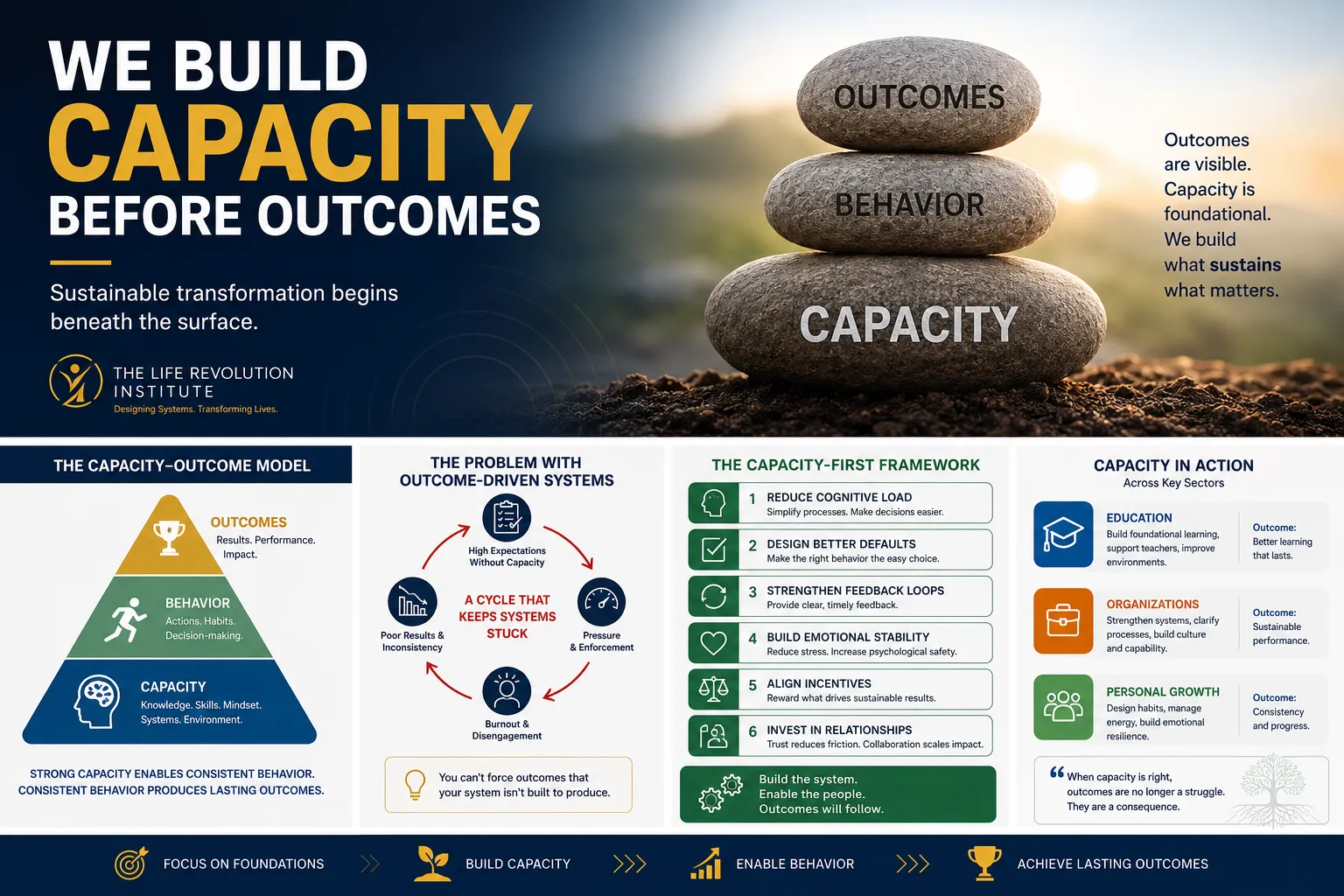
Why Sustainable Transformation Begins Beneath the Surface
In a world obsessed with outcomes, metrics, and visible success, a dangerous assumption has quietly taken root across institutions, organizations, and even personal development spaces: that outcomes can be engineered directly.
We measure progress by what we can see—profits, grades, weight loss, productivity, compliance rates, growth curves. We reward visible results. We design systems to chase them. And when those outcomes fail to materialize—or worse, fail to sustain—we respond with more pressure, more instruction, more enforcement.
But beneath this relentless pursuit lies a structural flaw.
Outcomes are not primary. They are derivative.
At The Life Revolution Institute, we operate from a fundamentally different premise:
We build capacity before outcomes.
Capacity → Enables Behavior → Produces Outcomes
This is not a philosophical preference. It is a systems principle. A developmental law. A structural truth about how human beings, organizations, and societies actually change.
If you ignore capacity and pursue outcomes directly, you may achieve short-term results—but you will not achieve stability, resilience, or scale. Eventually, the system collapses under the weight of expectations it was never built to carry.
This article explores what capacity truly means, why it precedes outcomes, and how designing for capacity transforms everything—from leadership and education to governance and personal growth.
The Illusion of Outcome-Driven Change
Modern systems are overwhelmingly outcome-driven.
Schools focus on test scores. Businesses focus on quarterly profits. Governments focus on compliance rates. Individuals focus on visible achievements—titles, income, recognition.
This orientation creates a powerful illusion: that if we can define the right goals and enforce the right behaviors, outcomes will follow.
So we design interventions like:
- More training programs
- Stricter rules
- Increased monitoring
- Incentives and penalties
- Motivational messaging
These are all forms of instructional control—attempts to shape behavior directly.
But here is the problem:
Instruction assumes capacity.
It assumes that individuals already possess:
- The cognitive ability to process information
- The emotional regulation to act consistently
- The environmental stability to sustain change
- The internal motivation to persist
When these conditions are absent, instruction fails—not because people are unwilling, but because the system is misaligned with reality.
This is why we see persistent gaps between:
- Policy and practice
- Knowledge and behavior
- Intention and execution
The issue is not effort. It is architecture.
What Is Capacity?
Capacity is often misunderstood as skill or knowledge. It is far deeper than that.
Capacity is the underlying ability of a system—human or institutional—to consistently produce, sustain, and adapt outcomes under varying conditions.
It is multidimensional.
1. Cognitive Capacity
The ability to understand, reason, and make decisions.
2. Emotional Capacity
The ability to regulate emotions, manage stress, and maintain stability under pressure.
3. Behavioral Capacity
The ability to translate intention into consistent action.
4. Environmental Capacity
The degree to which external conditions support or hinder performance.
5. Relational Capacity
The strength of networks, trust systems, and social cohesion.
6. Structural Capacity
The design of systems, processes, and institutions that enable or constrain behavior.
When capacity is high, outcomes become predictable.
When capacity is low, outcomes become fragile, inconsistent, or unsustainable.
The Capacity–Outcome Relationship
Capacity → Enables Behavior → Produces Outcomes
Outcomes are not independent variables. They are emergent properties.
You cannot sustainably improve outcomes without first upgrading the system that produces them.
Think of it this way:
- You cannot improve crop yield without improving soil quality.
- You cannot improve athletic performance without building physical conditioning.
- You cannot improve organizational results without strengthening internal systems.
Yet many interventions attempt exactly that—forcing yield without nourishing the soil.
This leads to:
- Burnout
- Compliance without understanding
- Short-term gains followed by regression
- Increasing dependence on external enforcement
Capacity acts as a multiplier.
If capacity is low, even high effort produces limited results.
If capacity is high, even moderate effort produces strong results.
Why Institutions Fail Without Capacity
Many institutions are designed around instruction rather than capacity.
They assume:
- People will comply if rules are clear
- People will perform if incentives are strong
- People will change if information is available
But behavioral science—and real-world observation—tell a different story.
Humans are:
- Not fully rational
- Highly context-dependent
- Influenced by defaults and environment
When institutions ignore this, they create systems that require constant enforcement.
The Cost of Ignoring Capacity
Low Capacity → Poor Outcomes → More Pressure → Burnout → Worse Outcomes
- Compliance Gaps
People know what to do but fail to do it consistently. - Enforcement Overload
Systems require increasing resources to maintain order. - Fragility
Outcomes collapse when supervision is removed. - Inequality Amplification
Those with existing capacity succeed; others fall behind. - Institutional Distrust
People disengage when systems feel misaligned with reality.
In contrast, capacity-driven systems reduce the need for enforcement because they make desired behaviors easier, more natural, and more sustainable.
Capacity as Infrastructure
Better Design → Easier Behavior → Improved Outcomes → Reinforces System → Higher Capacity
One of the most useful ways to understand capacity is to think of it as infrastructure.
Just as physical infrastructure enables economic activity, capacity enables behavioral and institutional performance.
You would not expect a city to function without:
- Roads
- Electricity
- Water systems
Yet many systems expect high performance without building:
- Cognitive infrastructure (education quality)
- Emotional infrastructure (mental resilience)
- Structural infrastructure (efficient processes)
- Social infrastructure (trust networks)
This mismatch creates systemic strain.
When capacity is absent, systems compensate with:
- Pressure
- Punishment
- Surveillance
But these are substitutes, not solutions.
The Principle: Build Capacity First
Better Design → Easier Behavior → Improved Outcomes → Reinforces System → Higher Capacity
At The Life Revolution Institute, we apply a simple but powerful principle:
Do not demand what the system cannot support. Build the system first.
This requires a shift in sequence:
Instead of:
Define outcome → Demand performance → Enforce compliance
We design:
Build capacity → Enable behavior → Outcomes emerge
This shift has profound implications.
Designing for Capacity: A Systems Approach
Building capacity is not about adding more training or information. It is about redesigning systems to align with how humans actually function.
1. Reduce Cognitive Load
Complex systems overwhelm decision-making.
Capacity increases when:
- Processes are simplified
- Choices are structured
- Information is clear and actionable
2. Design Better Defaults
People tend to follow the path of least resistance.
Instead of forcing behavior, design environments where:
- The desired action is the easiest action
- The undesired action requires effort
3. Strengthen Feedback Loops
Capacity grows through feedback.
Effective systems:
- Provide immediate, clear feedback
- Reinforce positive behaviors
- Allow for rapid adjustment
4. Build Emotional Stability
Stress reduces capacity.
Systems must:
- Avoid chronic overload
- Provide psychological safety
- Enable recovery and resilience
5. Align Incentives with Reality
Misaligned incentives distort behavior.
Capacity-driven systems ensure that:
- Incentives reinforce sustainable actions
- Short-term rewards do not undermine long-term outcomes
6. Invest in Relationships
Trust increases system efficiency.
High relational capacity leads to:
- Better collaboration
- Faster coordination
- Lower enforcement costs
Case Study Thinking: Education
Consider education systems that focus heavily on exam performance.
An outcome-driven approach:
- Increases testing frequency
- Enforces study schedules
- Rewards high scores
But if students lack:
- Foundational understanding
- Emotional stability
- Learning strategies
- Supportive environments
Then performance becomes inconsistent.
A capacity-driven approach would:
- Strengthen foundational literacy and numeracy
- Teach learning how to learn
- Build emotional resilience
- Improve classroom environments
The result? Outcomes improve naturally—and sustainably.
Case Study Thinking: Organizations
In many organizations, leadership demands higher productivity.
The typical response:
- Set more aggressive targets
- Increase monitoring
- Introduce performance incentives
But if employees lack:
- Clear processes
- Adequate tools
- Psychological safety
- Decision-making autonomy
Then productivity gains are temporary at best.
A capacity-first organization:
- Streamlines workflows
- Reduces friction
- Invests in capability development
- Builds a culture of trust
Here, performance is not forced—it emerges.
Capacity and Personal Transformation
This principle applies just as strongly at the individual level.
People often set goals like:
- “I want to be more disciplined”
- “I want to be more productive”
- “I want to be consistent”
But these are outcome statements.
Without capacity, they fail.
Capacity-Based Personal Change
Instead of focusing on outcomes, focus on:
- Energy management (sleep, nutrition, recovery)
- Environment design (removing friction, adding cues)
- Habit systems (small, repeatable actions)
- Emotional regulation (managing stress and triggers)
When capacity increases, behavior becomes easier—and consistency follows.
The Time Horizon Problem
One reason capacity is neglected is that it operates on a different time horizon than outcomes.
- Outcomes are immediate and visible
- Capacity is gradual and often invisible
This creates a bias toward short-term thinking.
Leaders and individuals alike are pressured to show quick results, leading to:
- Overemphasis on outputs
- Underinvestment in foundations
But this is a strategic error.
Short-term outcomes without capacity create long-term instability.
Capacity investment may delay outcomes—but ensures their durability.
Measuring Capacity
A common challenge is that capacity is harder to measure than outcomes.
But it is not unmeasurable.
Indicators of capacity include:
- Consistency of performance
- Resilience under stress
- Reduced need for supervision
- Speed of adaptation
- Quality of decision-making
These metrics provide a deeper view of system health than surface-level results.
The Ethical Dimension
There is also an ethical argument for building capacity first.
Demanding outcomes without providing capacity is fundamentally unjust.
It places responsibility on individuals without equipping them with the means to succeed.
This is particularly relevant in:
- Education systems
- Workforce development
- Public policy
A capacity-first approach recognizes that:
- Performance is not just a matter of will
- Systems shape behavior
- Responsibility must be matched with support
From Control to Design
At its core, the shift from outcomes to capacity is a shift from control to design.
Control tries to force behavior.
Design shapes the conditions under which behavior occurs.
Control is reactive.
Design is proactive.
Control is resource-intensive.
Design is efficient.
The most effective systems in the world are not those that enforce behavior the hardest—but those that make the right behavior the easiest.
The Life Revolution Perspective
The Life Revolution Institute exists to reframe how transformation is understood and implemented.
We do not begin with outcomes.
We begin with:
- System architecture
- Human behavior
- Capacity constraints
Our work focuses on:
- Diagnosing capacity gaps
- Designing enabling environments
- Building sustainable systems
Because we understand a simple truth:
You cannot scale what you have not stabilized.
And stability comes from capacity.
Conclusion: Build the Foundation
If there is one principle to carry forward, it is this:
Stop chasing outcomes in isolation. Start building the capacity that makes them inevitable.
Better Design → Easier Behavior → Improved Outcomes → Reinforces System → Higher Capacity
Whether you are:
- Leading an organization
- Designing a policy
- Building a system
- Or transforming your own life
The sequence matters.
Do not ask:
“How do I get better results?”
Ask:
“What capacity is missing that makes these results difficult?”
Because once capacity is built:
- Behavior aligns
- Performance stabilizes
- Outcomes follow
Not by force.
But by design.
Final Thought
Outcomes are visible. Capacity is foundational.
Most people manage what they can see.
Leaders build what cannot yet be seen—but determines everything that will be.
At The Life Revolution Institute, we choose the latter.
Because when capacity is right, outcomes are no longer a struggle.
They are a consequence.